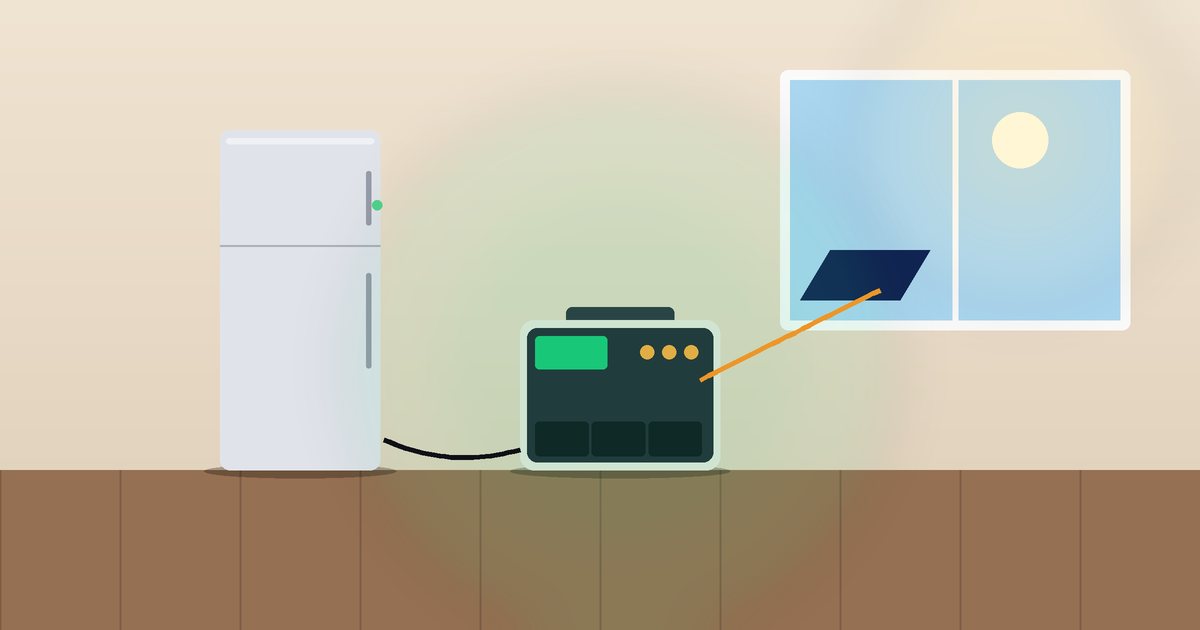
A solar generator for home use is a power station plus solar panels, and it can keep a refrigerator, a freezer, a router and some lights running through an outage. It cannot run a whole house for long. In the worked example below, must-run loads of about 2,130 Wh a day drain a 2,042 Wh unit in under a day without sun, while a 5,040 Wh unit lasts about two days. This guide shows how to size one, what the spec pages say and where the limits are.
We used official product pages and one solar industry article. We did not test any unit, so every figure comes from those sources or from simple math you can repeat.
What a solar generator for home use is
First, despite the name, a solar generator has no engine. It is a battery with an inverter and outlets, charged by solar panels, a wall outlet or both. Our explainer on portable power stations covers the parts in detail.
For a home, the useful questions are simple. How much energy does the battery hold, how many watts can it deliver at once, and how fast can the panels refill it?
What it can run, and what it cannot
A home solar generator suits the loads you must keep on. Think refrigeration, a router, phone chargers and a few lights. Our freezer wattage guide shows how gentle a freezer can be on average.
However, big heating and cooling loads are the problem. A central air conditioner, an electric dryer or an electric range can drain a battery in hours. Our portable AC guide shows the math for one air conditioner.
Start with your daily watt-hours
Everything depends on your daily use. Here is the example from our solar battery backup guide. The numbers are made up, so swap in your own.
| Load | Watt-hours per day |
|---|---|
| Refrigerator | about 1,100 |
| Chest freezer | about 590 |
| Wi-Fi router, 10 W all day | 240 |
| Four LED lights, five hours | 200 |
| Total | about 2,130 |
How many days does each unit last without sun?
A power station loses some energy converting battery power to household AC, and we count on about 85% of rated capacity as a planning rule. That is our rule of thumb, not a manufacturer spec. Divide the usable energy by 2,130 Wh to get days with no solar input at all.
| Model | Capacity | Usable (85%) | Days at 2,130 Wh a day |
|---|---|---|---|
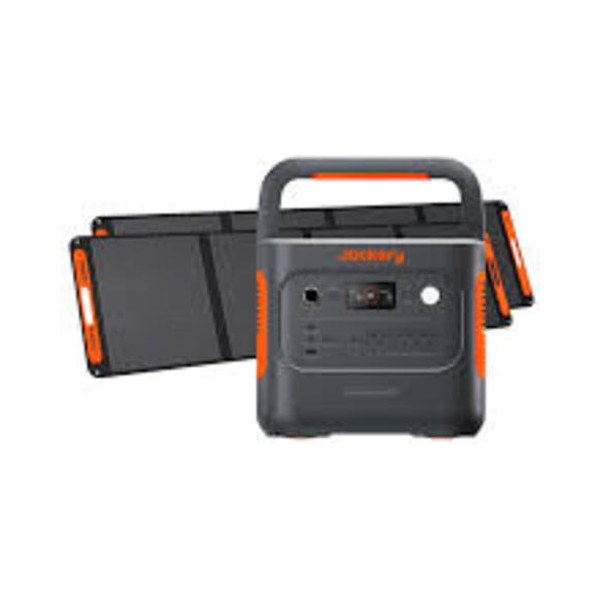
| Jackery Solar Generator 2000 v2 | 2,042 Wh | About 1,735 Wh | About 0.8 |
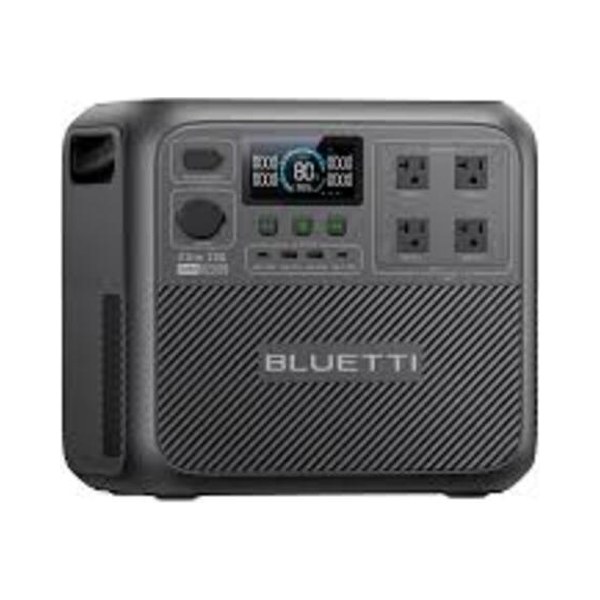
| Bluetti Elite 200 V2 | 2,073.6 Wh | About 1,763 Wh | About 0.8 |
| EcoFlow DELTA 3 Ultra Plus | 3,072 Wh | About 2,611 Wh | About 1.2 |
| Anker SOLIX F3800 Plus | 3,840 Wh | About 3,264 Wh | About 1.5 |
| Jackery Explorer 5000 Plus | 5,040 Wh | About 4,284 Wh | About 2.0 |
So the two 2,000 Wh units cover less than a day of our example. The largest covers about two. Overall, that is the honest picture of what a portable unit can do for a home.
Add solar panels
Panels extend the runtime. A 200 W panel in four hours of strong sun makes at most 800 Wh. After losses, plan on about 75%, or 600 Wh. That is our rule of thumb. The default Jackery Solar Generator 2000 v2 bundle includes two SolarSaga 200 W panels, so on a good sun day it could add about 1,200 Wh.
Use the 2,130 Wh example. For that setup, the battery loses about 930 Wh a day, so a 1,735 Wh usable battery lasts about 1.9 days on good sun days. Cloudy days shorten that. Our 200 watt solar panel guide explains the panel math.
Check the output, not only the capacity
Capacity is half of the story. Besides that, the unit must also deliver your running and starting watts. The spec pages list these ratings.
| Model | Output | Weight | Notes from the spec pages |
|---|---|---|---|
| Jackery Solar Generator 2000 v2 | 2,200 W, 4,400 W surge | 39.5 lb | Specs are for the station, not the panels |
| Bluetti Elite 200 V2 | 2,600 W | 53.4 lb | Surge not listed in our data |
| EcoFlow DELTA 3 Ultra Plus | 3,600 W, 7,200 W surge | Weight to be confirmed | Expandable from 3 to 11 kWh |
| Anker SOLIX F3800 Plus | 6,000 W combined 120/240 V total | 136.7 lb | 120 V outlets at 2,400 W max |
| Jackery Explorer 5000 Plus | 7,200 W, 14,400 W surge | 134.5 lb | Heavy loads, including 120/240 V |
Several of these pages need a careful read. For example, the EcoFlow surge figure appears on one page only, and its weight and warranty are still to be confirmed. The Anker 6,000 W figure is a combined total, not a figure for each outlet.
Portable unit or installed home battery?
A portable unit is the simple route. You plug in a few appliances and carry it away when you leave. However, it holds far less than an installed system.
Aurora Solar says a typical home battery is about 10 to 15 kWh. That is two to three times the largest unit in our table. An installed battery also ties into your home wiring, which needs a licensed installer. Our home battery backup guide covers that route.
Also note that rooftop panels alone do not keep power on. Aurora Solar says a grid-tied system stops delivering electricity to your home when the grid goes down, to protect line workers. So a home with rooftop solar still needs a battery or a portable setup.
When a gas generator fits better
Fuel can be refilled, but a battery cannot recharge without sun or grid power. So for a long outage with heavy loads, a gas unit may fit better. Our portable generator for home backup guide compares sizes, and our solar vs gas generator comparison puts both side by side.
What to check before you buy
- Daily watt-hours. Add up your must-run loads first.
- Capacity and output. Cover both the energy and the watts.
- Panel input. Check the solar input limits before you pick panels.
- Weight. A 134.5 lb unit stays in one place.
- Warranty. Jackery lists 5 years for the 5,000 Plus and Bluetti lists 5 years on the pages we checked. Read the terms.
Common mistakes
- Expecting a whole house. A portable unit covers a short list of loads.
- Counting panel watts as daily energy. A 200 W panel makes about 600 Wh a day by our rule, not 200 W all day.
- Ignoring conversion losses. Plan on about 85% of the rated capacity.
- Forgetting the surge. A compressor may need far more than its running watts.
- Skipping the connector check. Panels and stations must match.
The bottom line
A solar generator for home use works for a short list of must-run loads, not for a whole house. Add up your daily watt-hours first, then pick a unit whose capacity covers a day or two and whose output covers your surge. For a longer outage, add panels, add a second battery where the page allows it, or plan a gas unit as a partner.