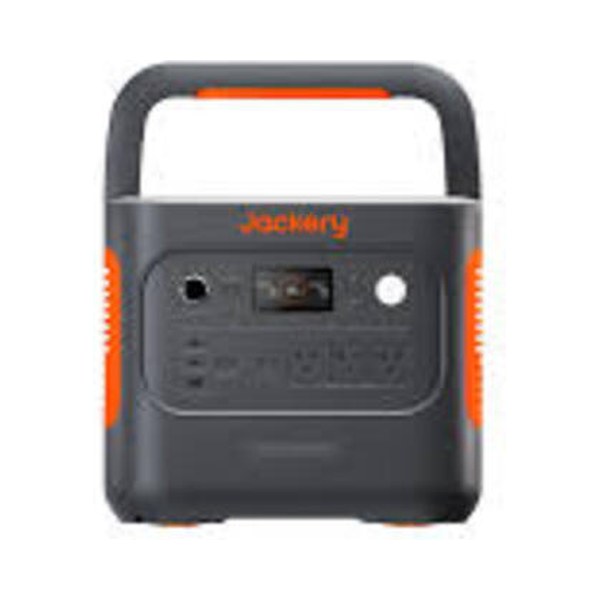
We compared the official spec sheets of four power stations for this guide. We did not test them on a freezer ourselves, so every figure comes from the manufacturers, from ENERGY STAR or from simple math you can repeat.
How many watts does a freezer use? Running watts and average watts
A freezer has two kinds of power numbers, and people mix them up.
Running watts tell you what the freezer pulls while the compressor is on. You find them on the nameplate, usually inside the cabinet or on the back. If the label lists amps instead of watts, multiply amps by volts. As an example, 1.5 amps at 120 volts is 180 watts. That figure is only an illustration, so use the numbers on your own label.
Average watts tell you what the freezer pulls over a full day. The compressor rests between cycles, so the average sits far below the running figure. Battery planning depends on the average. The power station's output rating, on the other hand, has to cover the running watts and the startup surge.
So you need both numbers. The first tells you whether the power station can carry the load at any moment. The second tells you how long the battery will last.
Chest freezer wattage compared with upright
ENERGY STAR gives yearly figures for certified models. A chest freezer uses about 215 kWh and costs about $30 a year to run. An upright uses about 395 kWh and costs about $60. The page also explains why the chest design wins: the door opens from the top, so less cold air escapes.
Here is how those yearly numbers turn into chest freezer wattage you can use for planning:
The math is simple. Divide the yearly kWh by 365 to get kWh per day. Then multiply by 1,000 to get watt-hours. Divide again by 24 to get the average watts.
Keep two limits in mind. These figures describe certified new models, and older freezers often use more. Size also matters, because ENERGY STAR notes that a larger freezer uses more energy. Treat the table as a starting point and swap in the yearly kWh from your own EnergyGuide label.
How many watts does a deep freezer use?
People often say "deep freezer" for a chest freezer, so the numbers above apply. If you ask how many watts does a deep freezer use, expect a low average, about 25 watts for a certified chest model, and a higher draw while the compressor runs.
An old freezer can tell a different story. ENERGY STAR notes that new certified models beat older ones, so an older unit may draw more than the table shows. If you are unsure, a plug-in watt meter will show the real draw over a day or two.
Check the startup surge
The compressor pulls a short burst of power when it starts. That burst is the startup surge, and it can run several times higher than the running watts. The manual or label sometimes lists it. When it does not, pick a power station whose surge rating leaves plenty of room.
All four models we compared offer far more output than a single freezer needs:
- Jackery Explorer 1000 v2: 1,070 Wh, 1,500 W rated, 3,000 W surge.
- Bluetti AC180: 1,152 Wh, 1,800 W rated, 2,700 W surge.
- Anker SOLIX C1000 Gen 2: 1,024 Wh, 2,000 W rated, 3,000 W surge.
- Jackery Explorer 2000 v2: 2,042 Wh, 2,200 W rated, 4,400 W surge.
The real difference shows up in watt-hours and weight.
Turn the average into hours of backup
Capacity in watt-hours works like the size of a fuel tank. The freezer sips from it. The bigger the tank, the longer you run.
The power station loses some energy when it converts battery power to household AC. A common planning rule is to count on about 85% of the rated capacity. That is our rule of thumb, not a manufacturer figure.
Here is the math with the Jackery Explorer 1000 v2. Its 1,070 Wh times 0.85 gives about 910 usable Wh. Divide by 25 W for a chest freezer and you get roughly 37 hours. Divide by 45 W for an upright and you get roughly 20 hours.
For the Jackery Explorer 2000 v2, 2,042 Wh times 0.85 gives about 1,735 usable Wh. That stretches to about 70 hours for the chest freezer and about 38 hours for the upright.
In practice, real runs come out shorter. For example, a warm room, a freezer full of just-added food and frequent door openings all raise the draw. I would cut the result by about a quarter as a safety margin.
Which power station fits a freezer?
For a short outage of a day or so, a unit near 1,000 Wh covers most freezers. For several days, step up to about 2,000 Wh or add solar panels.
- Jackery Explorer 1000 v2 is the lightest of the group at 23.8 lb. Its 1,500 W output limits it to one or two mid-size appliances at a time.
- Bluetti AC180 adds a little more capacity and four AC outlets. At 35.27 lb in the spec table, it is heavier. The page also says 37 lb elsewhere, so confirm before you buy if weight matters.
- Anker SOLIX C1000 Gen 2 offers 2,000 W of output in a 24.9 lb body. The page leaves its battery chemistry and warranty to be confirmed, so check both on the retailer page.
- Jackery Explorer 2000 v2 gives the longest runtime here. At 39.5 lb, it is heavy to carry far, so plan to leave it in one spot.
Prices and availability change often, so check the retailer page before you decide.
Freezer plus fridge: add the averages
Many homes need to protect both appliances. The method stays the same. Add the average watts of each, then divide your usable watt-hours by the total.
Say a chest freezer averages 25 W and a refrigerator averages 46 W. Those are examples. Together they draw about 71 W. On the Jackery Explorer 1000 v2, 910 usable Wh divided by 71 W gives about 13 hours. On the Explorer 2000 v2, 1,735 usable Wh gives about 24 hours. Our guide to battery backup for a refrigerator walks through the fridge side of the math.
Do you need a solar freezer setup?
People use "solar freezer" and "solar powered freezer" for two different things. The first is a regular freezer that runs from a power station you recharge with solar panels. This suits a long outage. The second is a freezer built to run on DC power, which suits cabins and RVs. That second type is a separate product and not covered here.
Here is the panel math for the first setup, with example numbers. A 200 W panel in four hours of strong sun makes at most 800 Wh. After losses, plan on about 75% of that, or 600 Wh. A chest freezer at about 590 Wh a day is close to that figure, so one 200 W panel nearly covers it on a good day. An upright at about 1,080 Wh needs closer to two panels. Clouds, panel angle and season change the result, so treat this as a rough guide.
A solar powered freezer setup needs panels, a charge input on the power station and a spot with sun. For more on panel sizes, see our 200 watt solar panel guide.
How long does food last without power?
A running freezer matters because food thaws fast without cold air. The CDC says a full freezer holds its temperature for about 48 hours if the door stays closed. A half-full freezer holds for about 24 hours.
For a short outage, you may not need a battery at all. Keep the door shut and the freezer will hold. A power station earns its place in longer outages and when a full freezer is at stake.
Mistakes that cut your runtime
- Plugging in too much. Lights, a router and a laptop draw from the same battery, so add them to the math.
- Opening the lid often. Each opening lets cold air out, and the compressor works harder to recover.
- Guessing the surge. A unit with enough watt-hours can still trip if its surge rating is too low for the compressor.
- Skipping the label. Good planning starts with your own freezer's numbers. Our air conditioner guide shows the same method for a much larger load.
The bottom line
So, how many watts does a freezer use? The label shows the running watts, but the daily average for a modern chest freezer is closer to 25 watts, and for an upright about 45 watts. Read your own label, add the startup surge and size the battery for the hours you need. A 1,000 Wh unit covers a day or more for one freezer. A 2,000 Wh unit stretches that to two or three days.