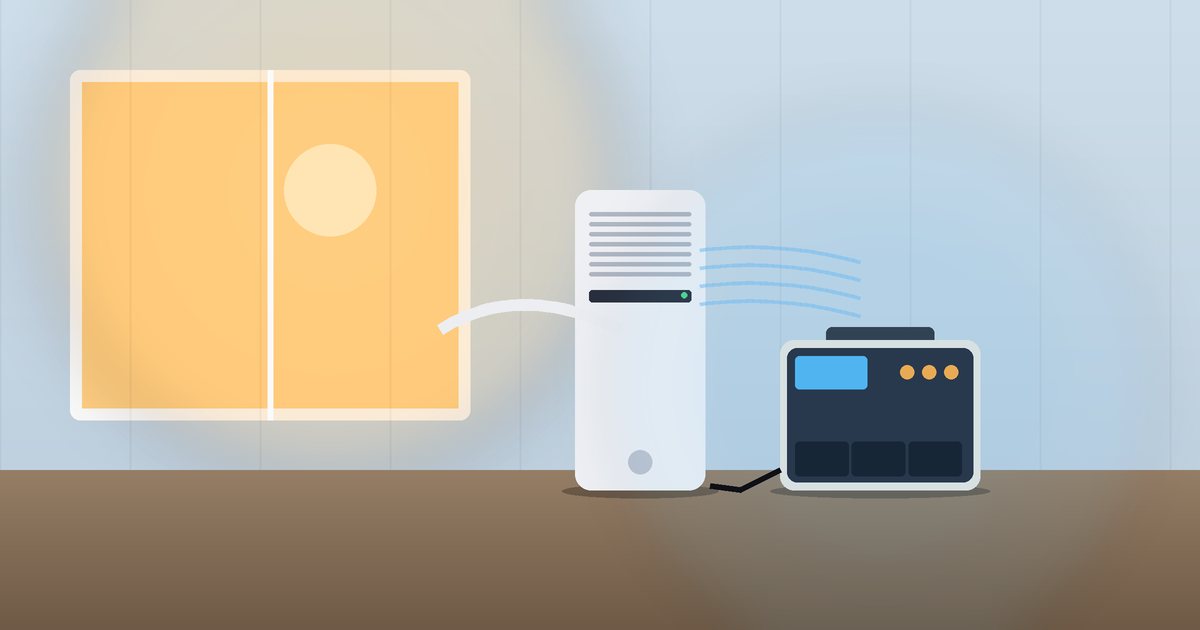
Portable AC watts decide whether a battery can carry your air conditioner. Most units pull far more power than a fridge or a freezer, so a portable power station can usually run one for only a few hours. In the worked example below, a 2,000 Wh class model runs a 1,000 W air conditioner for less than two hours of steady running. This guide shows how to read your unit's label, check the surge and decide whether the numbers work for you.
We compared the official spec sheets of four power stations for this guide. We did not run them against an air conditioner ourselves, so every figure comes from the manufacturers, a cited guide or math you can repeat.
Find your portable AC watts first
Start with the nameplate. It sits on the back or side of the unit, or on the first page of the manual. It lists volts and amps, and sometimes watts. If watts are missing, multiply volts by amps. For example, 8 amps at 120 volts is 960 watts. That is an example only, so use your own numbers.
Next, look at the BTU rating. BTU measures cooling power, not electricity. Two units with the same BTU rating can pull different watts, so the BTU number alone cannot size a battery.
For a rough idea, Bluetti's guide says an 8,000 BTU portable unit typically lands in the 700 to 1,200 watt zone while the compressor runs. It puts 12,000 BTU units around 1,000 to 1,500 watts. Those are a seller's estimates, so treat them as a starting range and trust your own label.
Why portable AC wattage is so hard on a battery
A refrigerator coasts. Its compressor rests much of the day. An air conditioner works hard whenever a room is hot, so the compressor runs for long stretches.
That is why portable ac wattage matters more than almost any other number here. The unit may draw close to its rated watts for hours. The Energy.gov page on room air conditioners also notes that a unit above 7.5 amps needs a dedicated circuit at home, which shows how much current these machines pull.
Heat makes it worse. A sunny room, an open door and a poorly sealed window all push the compressor to run longer.
Check the startup surge
When the compressor starts, it pulls a burst well above its running watts. Bluetti's guide gives one example: a unit rated near 1,200 watts might spike to 2,500 or even 3,000 watts for a second. That is one example, not a rule for every unit.
So the power station must meet two limits. Its rated output must cover the running watts, and its surge rating must cover the startup burst. Here is how the four models we compared stack up:
- Jackery Explorer 1000 v2: 1,070 Wh, 1,500 W rated, 3,000 W surge.
- Jackery Explorer 2000 v2: 2,042 Wh, 2,200 W rated, 4,400 W surge.
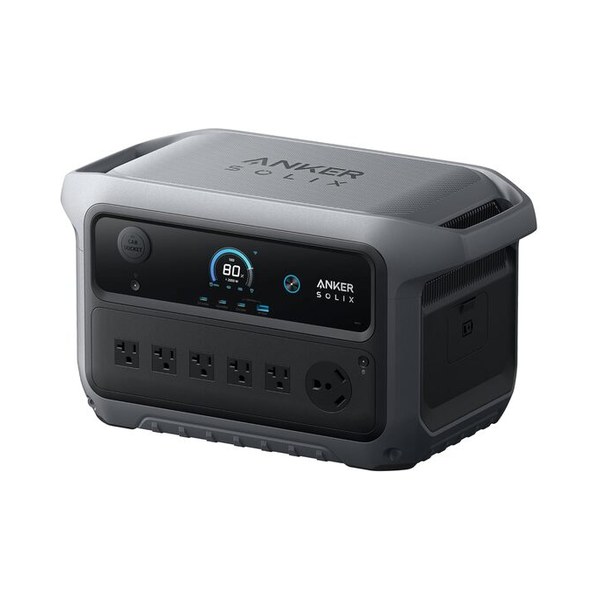
- Anker SOLIX C2000 Gen 2: 2,048 Wh, 2,400 W rated, 4,000 W surge.
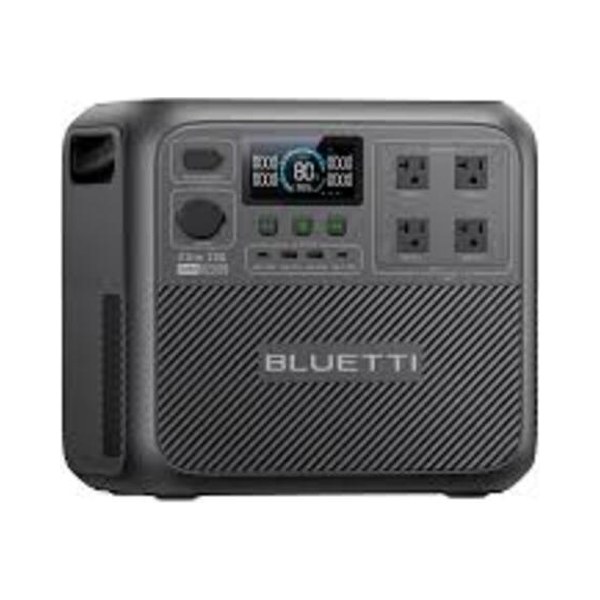
- Bluetti Elite 200 V2: 2,073.6 Wh, 2,600 W rated. The page we checked lists no separate surge figure.
If the manual does not list your unit's surge, pick a power station with room to spare.
Turn watts into hours
Capacity in watt-hours works like the size of a fuel tank. The air conditioner drinks from it quickly.
A power station loses some energy converting battery power to household AC. A common planning rule is to count on about 85% of rated capacity. That is our rule of thumb, not a manufacturer figure.
Here is the math with an example unit that draws 1,000 W while running:
- Jackery Explorer 1000 v2: 1,070 Wh times 0.85 gives about 910 usable Wh. Divide by 1,000 W and you get about 55 minutes.
- Jackery Explorer 2000 v2: 2,042 Wh times 0.85 gives about 1,735 usable Wh. That is about 1 hour and 45 minutes.
- Anker SOLIX C2000 Gen 2: 2,048 Wh times 0.85 gives about 1,740 usable Wh, or about 1 hour and 45 minutes.
Your unit may draw less. Bluetti's range for an 8,000 BTU unit starts at 700 W. At that draw, the Jackery Explorer 2000 v2's 1,735 usable Wh would last about 2.5 hours. At the top of the range, 1,200 W, the same battery would last about 1.4 hours. So the range from your label matters a great deal.
Real runs come out a bit shorter. In practice, a hot room keeps the compressor on and the draw near its peak. I would cut these times by about a quarter as a safety margin.
The thermostat helps in one way. Once the room cools, the compressor cycles off part of the time, so the average draw drops below the running watts. How much it drops depends on your room and weather, so we cannot give you a reliable figure.
Which power station fits an air conditioner?
For a small unit and a short run, a 1,000 Wh class model can work. For longer use, you want 2,000 Wh or more.
- Jackery Explorer 1000 v2 is the lightest at 23.8 lb. Its 1,500 W output limits it to smaller air conditioners, and it will not run long.
- Jackery Explorer 2000 v2 has 2,200 W of output and a 4,400 W surge rating. At 39.5 lb, it is heavy to carry far.
- Anker SOLIX C2000 Gen 2 lists 2,400 W and a TT-30R outlet. At 41.7 lb, it is also heavy. The page leaves its warranty to be confirmed, and it is a marketing page, not a product page.
- Bluetti Elite 200 V2 has the highest output here at 2,600 W. It weighs 53.4 lb, so plan to leave it in one spot.
Prices and availability change often, so check the retailer page before you decide.
Can solar power an RV air conditioner?
People search for an RV solar air conditioner because they want to run cooling off the grid. The honest answer is that it takes a large setup.
Take the 1,000 W example. Over one hour it uses 1,000 Wh. A 200 W panel in four hours of strong sun makes at most 800 Wh, and after losses about 600 Wh. So one panel covers well under an hour of cooling per day. Running solar power for an RV air conditioner through an afternoon needs a big battery and many panels, or a different plan.
A more realistic use is to let solar recharge a power station that runs your fans, lights and a small cooling device, and to save the air conditioner for short periods. Our 200 watt solar panel guide shows what one panel can do.
Lower the load before you buy a bigger battery
A bigger battery costs money and weight. Cutting the load is cheaper. Energy.gov says an oversized room unit cools too quickly without removing humidity well, so a right-sized unit often works better. Shade the window, close the curtains and cool only the room you use. Each change shortens the time the compressor runs.
You can also compare your air conditioner to a fan. A fan draws a small fraction of the power, so it stretches a battery much further, even though it does not cool the air the same way.
Check these four things before you buy
- Surge rating. Compare it to your unit's startup surge and leave a margin.
- Outlets. Confirm the plug type matches. The Anker SOLIX C2000 Gen 2 lists a TT-30R outlet, which suits some RV plugs.
- Weight. Plan where the unit will sit. A 53.4 lb unit stays put.
- Warranty. Jackery lists 3+2 years and Bluetti lists 5 years on the pages we checked. Read the terms before you buy.
Compare an air conditioner with your other loads
A refrigerator averages tens of watts. Our guide to battery backup for a refrigerator shows an example fridge near 46 W on average, and our freezer wattage guide shows a chest freezer near 25 W. In our 1,000 W example, an air conditioner draws about 20 times that. So if your goal is a long outage, protect the fridge and freezer first, and treat cooling as a short bonus.
The bottom line
Check your portable ac watts on the nameplate, then compare both the running watts and the startup surge to the power station's ratings. A 2,000 Wh class model runs a 1,000 W unit for under two hours. Lower the load, shade the room and use a fan where you can. For a full day of air conditioning, a battery is usually the wrong tool, and a generator or a much larger system fits better.