If you need battery backup for refrigerator use, a portable power station is a realistic option, as long as the unit handles the fridge's startup surge and holds enough watt-hours for the hours you need. In the worked example below, a 1,000 Wh class model keeps a typical fridge running for about 20 hours. A 2,000 Wh class model stretches that to about 37 hours. Your fridge will differ, so this guide shows how to run the numbers on your own.
We compared the official spec sheets of four models for this guide. We did not run them against a fridge ourselves, so every figure below comes from the manufacturers or from simple math you can repeat.
Runtime estimates are based on manufacturer specifications and simplified calculations. Actual runtime depends on your refrigerator, ambient temperature, door openings, battery condition and any other devices connected to the power station.
Disclosure: This article may contain affiliate links. We may earn a commission if you buy through them, at no extra cost to you.
Find your refrigerator's numbers first
To plan battery backup for refrigerator use, you need two numbers from your fridge: its running watts and its yearly energy use.
First, look inside the fridge for a sticker on a side wall or near the top. It lists volts, amps and sometimes watts. Multiply volts by amps if watts are missing. Then find the yellow EnergyGuide label, or the model number in the manual, for the yearly energy use in kilowatt-hours (kWh).
Why both? Running watts tell you whether the power station can carry the load at any moment. Yearly kWh tell you how much energy the fridge pulls over a day, which sets how long a battery lasts.
Check the startup surge
A refrigerator does not draw a steady flow of power. The compressor cycles on and off, and each time it starts, it pulls a short burst well above its running watts. That burst is the startup surge, also called starting watts.
The power station has to ride through it, so battery backup for refrigerator use needs a healthy surge rating. Compare the surge on your fridge's label or manual to the surge rating of the power station. If the manual does not list it, plan for a figure several times your running watts and pick a unit with room to spare.
Here is how the four models we looked at compare on output:
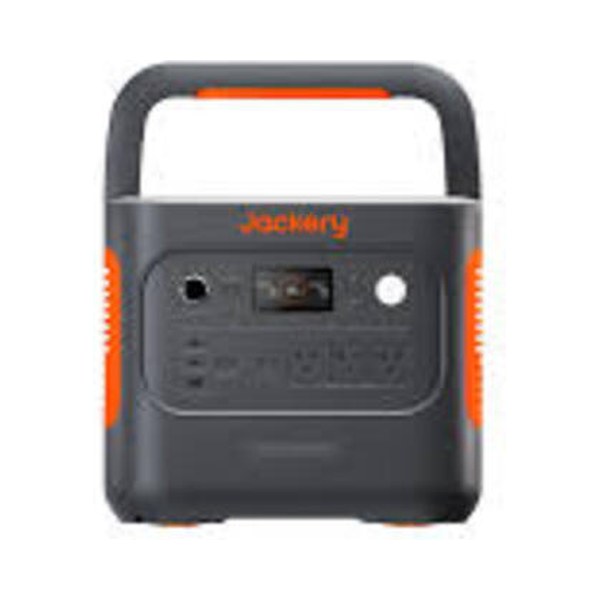
- Jackery Explorer 1000 v2: 1,070 Wh, 1,500 W rated, 3,000 W manufacturer-rated surge (peak) power.
- EcoFlow DELTA 3 Plus: 1,024 Wh, 1,800 W rated, 3,600 W manufacturer-rated surge (peak) power.
- Bluetti AC180: 1,152 Wh, 1,800 W rated, 2,700 W manufacturer-rated surge (peak) power.
- Jackery Explorer 2000 v2: 2,042 Wh, 2,200 W rated, 4,400 W manufacturer-rated surge (peak) power.
All four offer more output than most standard fridges need, provided the refrigerator’s compressor startup surge stays within the selected model’s surge limit. However, the real difference shows up in watt-hours and weight.
Turn kWh into hours of backup
Capacity in watt-hours works like the size of a gas tank. Your fridge sips from it. The bigger the tank, the longer you drive.
Here is the math, using an example fridge. Say its label reads 400 kWh per year. That number is only an example, so swap in yours.
- Convert to watt-hours: 400 kWh × 1,000 = 400,000 Wh per year.
- Divide by 365 days: about 1,100 Wh per day.
- Divide by 24 hours: about 46 W on average. That is the figure that matters for runtime, because the compressor rests part of the time.
- Take 85% of the battery as usable. The power station loses some energy converting battery power to household AC. Treat 85% as a planning rule of thumb, not a manufacturer spec.
- Divide usable watt-hours by the average watts.
For the Jackery Explorer 1000 v2, 1,070 Wh × 0.85 is about 910 Wh. Divide by 46 W and you get roughly 20 hours. For the Explorer 2000 v2, 2,042 Wh × 0.85 is about 1,735 Wh, or roughly 37 hours.
In practice, real life runs shorter. For example, opening the door, a warm kitchen and a fridge full of warm groceries all raise the draw. Plan to cut the result by about a quarter as a safety margin.
Battery backup for refrigerator: which power stations fit?
For a short outage of one night, a unit near 1,000 Wh covers most fridges. For a day or more, step up to about 2,000 Wh or add solar panels.
- Jackery Explorer 1000 v2 is the lightest of the group at 23.8 lb. Its 1,500 W output limits it to one or two mid-size appliances at a time.
- EcoFlow DELTA 3 Plus has six AC outlets on the US version (the number varies by region), handy if you want to run the fridge plus a few small devices. At about 27.6 lb it weighs more than similar-size units.
- Bluetti AC180 has the most capacity of the three smaller units. The manufacturer's spec table lists 35.27 lb, while another part of its page says 37 lb, so confirm before you buy if weight matters.
- Jackery Explorer 2000 v2 gives the longest runtime here. At 39.5 lb, it is heavy to carry far, so plan to leave it in one spot.
Prices and availability change often, so check the retailer page before you decide.
Fridge plus freezer: add the numbers
Many homes need battery backup for refrigerator and freezer together. The math stays simple. Add the average watts of both, then divide your usable watt-hours by that total.
Say the freezer averages 35 W. That is an example, so check the label on yours. Add it to the fridge's 46 W and you get 81 W. On the Jackery Explorer 1000 v2, 910 usable Wh divided by 81 W gives about 11 hours. On the Explorer 2000 v2, 1,735 usable Wh gives about 21 hours.
That is why the freezer deserves its own plan. The CDC says a full freezer holds food for about 48 hours if the door stays shut. For a short outage, you may be able to leave the freezer alone and give the battery to the fridge.
What about a solar refrigerator?
People use "solar refrigerator" and "solar powered fridge" for two different setups.
First, a regular fridge powered by a power station that you recharge with solar panels. This works in a longer outage. The panels refill the battery during the day, and the fridge draws it down overnight. The panels must produce more energy than the fridge uses in a day, which depends on sun and panel size.
Second, some fridges are built to run on DC power. Those suit RVs and off-grid cabins. They are a different product and not covered here.
Here is the panel math with example numbers. A 200 W panel in four hours of strong sun makes at most 800 Wh. After losses, plan on about 75% of that, or 600 Wh. Your fridge, at 46 W on average, uses about 1,100 Wh per day. So one 200 W panel covers about half of a day's fridge energy, and two panels come close to covering all of it. Clouds, panel angle and season change the result, so treat this as a rough guide.
For a home fridge, the first setup is the practical one: it turns your power station into battery backup for refrigerator use that you can refill with solar panels. Our portable power station guide covers panel pairing in more detail.
Check these four things before you buy
Before you commit to a battery backup for refrigerator setup, run through four checks.
- Surge rating. Compare it to the surge on your fridge's label, and leave a margin.
- AC outlets. The Jackery models list three AC outlets, the EcoFlow six (US version) and the Bluetti four. You need one for the fridge and more if you add a freezer or a lamp.
- Weight. Plan where the unit will sit. A 39.5 lb unit stays put, while a 23.8 lb unit moves easily.
- Warranty. Jackery lists 3+2 years, while EcoFlow and Bluetti list up to 5 years, subject to the manufacturer’s terms, on the pages we checked. Read the terms before you buy, because they can depend on registration.
Keep the food safe, not just cold
A running fridge matters because food spoils fast without cold air. The CDC states that food stays safe up to 4 hours in a refrigerator if the doors stay closed. A full freezer holds for about 48 hours, and a half-full freezer for about 24 hours.
For an outage under 4 hours, keeping the doors shut may be all you need. A power station earns its place in longer outages and when a full freezer is at stake. If your freezer is on the same battery, see how many watts a freezer uses in our freezer wattage guide.
Mistakes that cut your runtime
- Plugging in too much. Lights, a router and a laptop all draw from the same battery, so add them to the math.
- Opening the door often. Each open lets cold air out, and the compressor works harder to recover.
- Ignoring the surge. A unit with enough watt-hours can still trip if its surge rating is too low for the compressor.
- Skipping the sizing step. Good battery backup for refrigerator planning starts with adding up every appliance. If you want the full process, our generator sizing guide walks through adding up several appliances. For a plain-language explanation of the specs, read our explainer on portable power stations.
The bottom line
Yes, a portable power station can run a refrigerator. For battery backup for refrigerator use, check your fridge's surge and yearly kWh, then size the battery for the hours you need. A 1,000 Wh unit covers a night. A 2,000 Wh unit stretches toward a day and a half. Heavier units last longer but are harder to move, so match the size to how long your outages usually run.