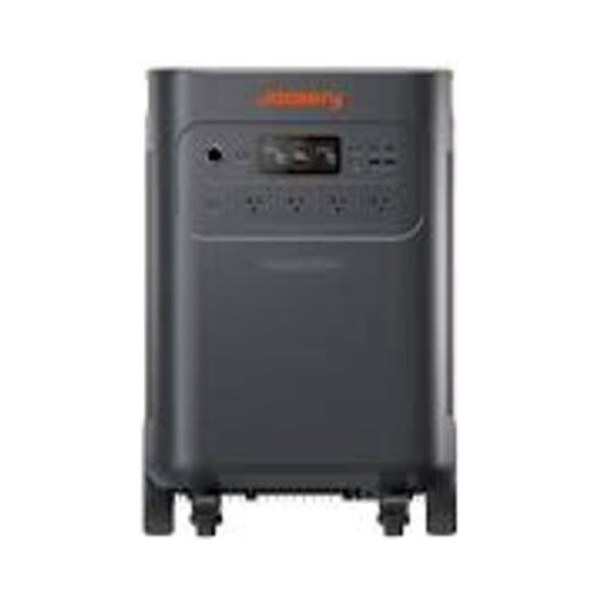
A power box, usually called a portable power station, is a battery with an inverter and a set of outlets in one case. You charge it from a wall outlet, a car port or solar panels, and you plug your devices into it. It makes no exhaust and has no engine. The size you need depends on two numbers: capacity in watt-hours, which sets how long it runs, and output in watts, which sets what it can run. This guide explains each part, how to read a spec sheet and which size fits which job.
We used official product pages for the examples. We did not test any unit, so every figure comes from the manufacturers or from simple math you can repeat.
What is inside a power box
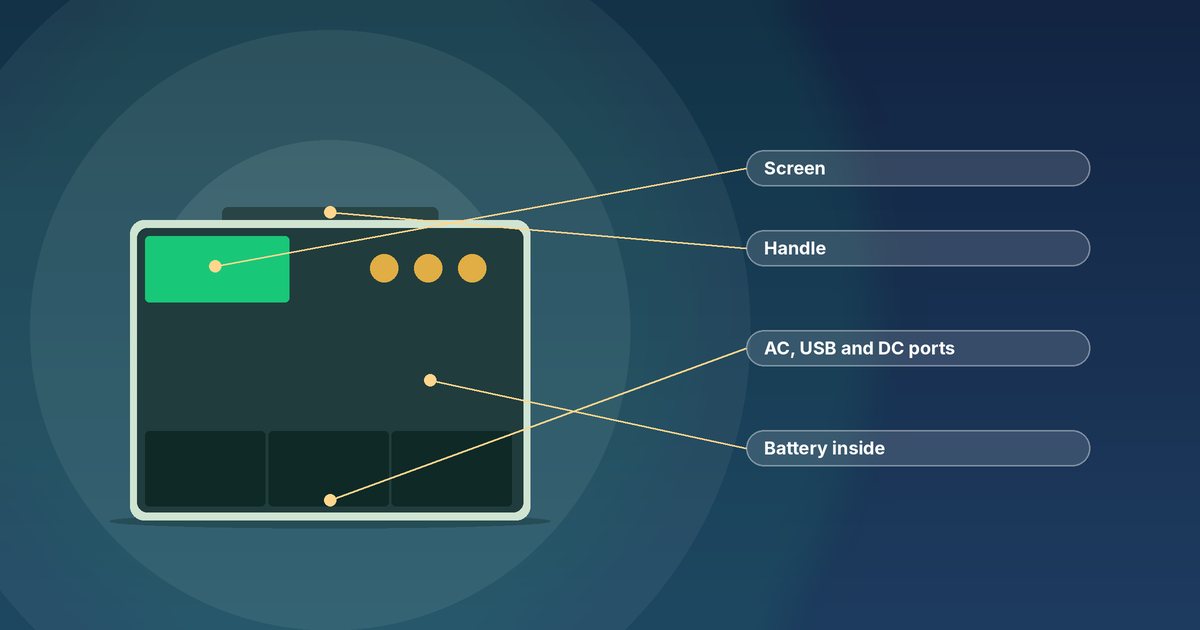
A portable power station has four main parts.
- A battery. It stores the energy. Most of the units in our list use lithium iron phosphate cells, shortened to LiFePO4 or LFP.
- An inverter. It turns the battery's direct current into the alternating current your appliances use.
- A charge controller. It manages how the battery fills, from a wall outlet, a car port or solar panels.
- Ports. AC outlets for household plugs, USB-A and USB-C for small devices and a 12 V car port.
Some people call it a powerbox, a powerstation or a portable outlet. These words all point to the same family of products, so you may see them used as a portable source of power.
Capacity and output: the two numbers that matter
Capacity, in watt-hours (Wh), works like the size of a fuel tank. A bigger number means more energy and a longer runtime. Output, in watts (W), is how much power the unit can deliver at once. It works like the size of the pipe. A bigger number means it can run bigger appliances.
Also, most specs list a surge rating. That is a short burst above the rated output, such as when a refrigerator compressor starts. If you run a motor, check the surge as well as the rated watts.
Here is how four units from our list compare.
Because weight climbs with capacity, think about where the unit will live. The largest unit is not portable in practice, so think of it as a fixed backup unit.
How long will it run?
To find runtime, divide the usable watt-hours by the watts you draw. A power station loses some energy converting battery power to household AC, and we count on about 85% of rated capacity as a planning rule. That is our rule of thumb, not a manufacturer spec.
Here are examples with made-up loads, so swap in your own.
- Jackery Explorer 300 v2, 60 W laptop: 288 Wh times 0.85 gives about 245 Wh. Divide by 60 W for about four hours.
- EcoFlow DELTA 3 Plus, 46 W refrigerator average: 1,024 Wh times 0.85 gives about 870 Wh. Divide by 46 W for about 19 hours.
- Jackery Explorer 2000 v2, same fridge: 2,042 Wh times 0.85 gives about 1,735 Wh, or about 37 hours.
In practice, real runs come out shorter, so cut the result by about a quarter as a margin. Our battery backup for refrigerator guide shows the fridge math in more detail.
What a power box can run
First, the rated output sets the limit. For example, a 300 W unit suits phones, a laptop and a light. A 1,800 W unit can run a refrigerator and a few devices. A 7,200 W unit can run heavy loads, including 120/240 V gear.
Because heating and cooling appliances draw a lot, they are the hardest loads. Our guide to portable AC watts shows why an air conditioner drains a battery fast, and our freezer wattage guide shows a much gentler load.
A walk through the ports
Ports tell you what you can plug in. The Jackery Explorer 300 v2 lists one AC outlet, a 100 W USB-C port, a 15 W USB-C port, a 15 W USB-A port and a 12 V car port. The EcoFlow DELTA 3 Plus lists six AC outlets, two 140 W USB-C ports, two 36 W USB-A ports, a car port and two DC5521 ports.
So a small unit suits a few devices, while a larger one can run several at once. However, all the AC outlets share one rated output. Check that your combined load stays under it.
Which size for which use
These are starting points. Add up your own loads first.
How you charge it
Most units charge three ways.
- From a wall outlet. This is the simplest, and you can top the unit up before a storm.
- From a car port. The pages list a 12 V car port. Check whether it works as an input or only as an output.
- From solar panels. A panel connects to the unit's solar input. Check the connector type and the input limits first. Our solar panel connectors guide explains how, and our 200 watt solar panel guide explains how much a panel makes.
What kind of battery?
Most of the units we looked at list LiFePO4 or LFP cells, and these are the types you will see most. Goal Zero, a power station maker, says LFP batteries have a higher thermal runaway temperature threshold than NMC cells, and says its newest LFP product has a cycle count over 4,000 and keeps about 80% of its capacity after that. These are the company's own claims, not independent tests. The same post says NMC has higher energy density, so a unit with NMC cells can be lighter for the same capacity.
So chemistry affects weight, lifespan and safety, because each type trades one for another. Check the page for your unit. For example, the Anker SOLIX C1000 Gen 2 page in our list leaves its battery chemistry to be confirmed.
Power station or power bank?
However, a power bank is smaller and has only USB ports. A power station adds the inverter and the AC outlets. So use a power bank for phones on a hike. Use a power station when you need to plug in a household device.
Power station or generator?
First, a generator runs as long as you add fuel and must run outdoors. A power station runs silently and needs no fuel, but it stops when the battery is empty. Our solar vs gas generator comparison goes through both.
What to check before you buy
- Capacity. Add up your loads and the hours you need.
- Output and surge. Make sure they cover your biggest appliance.
- Ports. Count the AC, USB-C and car outlets.
- Weight. Plan where the unit will sit or how far you will carry it.
- Warranty. Jackery lists 3+2 years and EcoFlow lists 5 years on the pages we checked. Read the terms.
Care and storage
The pages we checked give no care schedule, so follow the manual. In general, keep the unit dry and away from heat, and charge it before you need it. Because you may not touch it for months, check it from time to time. If the maker gives storage advice, follow that instead of our general tips.
Reading the fine print
Spec pages can hide small conflicts. For example, one page may give the weight in two places, or list a different port count in the table and in the text. When that happens, we use the spec table and say so. Do the same when you shop, and ask the seller to confirm anything that does not add up.
Common mistakes
- Buying on capacity alone. A big battery with low output cannot start a motor.
- Ignoring the surge. A compressor may need far more than its running watts.
- Forgetting conversion losses. Plan on about 85% of the rated capacity.
- Skipping the manual. Follow the maker's advice for placement and storage.
The bottom line
A power box is a battery with an inverter and outlets. Read two numbers, capacity and output, then check the surge and the weight. Add up your loads first, because that tells you which size to look at. A 300 Wh unit handles small electronics, a 1,000 Wh unit covers a night for a fridge and a 2,000 Wh unit stretches that toward a day and a half.