The best portable power station for camping is the smallest one that covers your loads for the length of the trip. For phones, a light and a laptop, a unit near 300 Wh is enough and weighs under 10 lb. For a fan, more devices or a few days off the grid, a unit near 1,000 Wh fits better. In the worked example below, a 288 Wh unit covers a light camp setup for about a day and a quarter. A 1,000 Wh class unit stretches that to about four days. Your gear will differ, so this guide shows how to add it up.
We compared official spec pages for this guide. We did not test any unit outdoors, so every figure comes from the manufacturers or from simple math you can repeat.
Why a portable power station for camping beats a generator
Many campgrounds limit generators. Boondockers Bible, a camping site, reports that most public-land campgrounds use 10 p.m. to 6 a.m. as quiet hours. It also says some national parks ban generators during quiet hours however quiet the machine is, and some campgrounds ban them all day. Each site sets its own rules, so ask before you go.
A battery has no engine, so it makes no exhaust and no engine noise. That is the main reason many campers choose a power station over portable generators for camping. The tradeoff is energy: a battery holds a fixed amount and then it is empty.
How much do you need? A sample camp plan
Here is a made-up plan for two people, so swap in your own numbers.
| Load | Calculation | Watt-hours per day |
|---|---|---|
| Two phones, two charges each | 4 × 15 Wh | 60 |
| LED lantern | 5 W × 5 h | 25 |
| Small fan | 20 W × 6 h | 120 |
| Total | about 205 |
A power station loses some energy converting battery power to household AC. We count on about 85% of rated capacity as a planning rule, which is our rule of thumb and not a manufacturer spec. The Jackery Explorer 300 v2 holds 288 Wh, so about 245 Wh is usable. That covers our example for about 1.2 days. The Jackery Explorer 1000 v2 holds 1,070 Wh, or about 910 usable Wh, which covers it for about 4.4 days.
Portable power station for camping: models we compared
| Model | Capacity | Output | Weight |
|---|---|---|---|
| Jackery Explorer 300 v2 | 288 Wh | 300 W | 8.16 lb |
| Bluetti Elite 30 V2 | 288 Wh | 600 W | 9.5 lb |
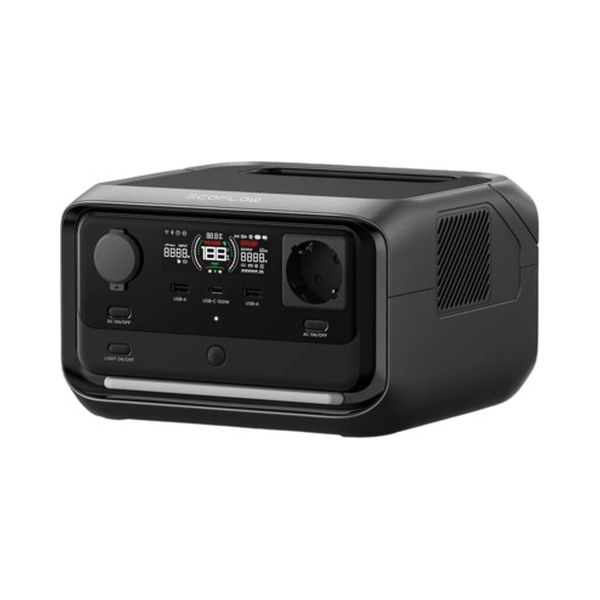
| EcoFlow RIVER 3 Plus | 286 Wh | 600 W | 10.4 lb |
| Jackery Explorer 1000 v2 | 1,070 Wh | 1,500 W | 23.8 lb |
All four use LiFePO4 batteries. Here are the details that matter for camping.
- Jackery Explorer 300 v2 is the lightest. Its page lists one AC outlet in the spec table, while other text mentions dual 300 W outputs, so confirm the count.
- Bluetti Elite 30 V2 lists 9 output ports and a 5-year warranty. The page gives its weight in kilograms only, so we converted it.
- EcoFlow RIVER 3 Plus lists three AC outlets and a 5-year warranty. The page says you can expand it to 858 Wh with the Extra Battery. It does not state a surge rating.
- Jackery Explorer 1000 v2 suits car camping. At 23.8 lb, you will want to carry it only a short way.
Prices and availability change often, so check the retailer page before you decide.
Power station or generator at camp?
Here is a quick comparison using spec numbers. The Honda EU2200i inverter generator weighs 47.4 lb and lists 57 dB(A) at rated load. The Jackery Explorer 1000 v2 power station weighs 23.8 lb and has no engine. So the battery is lighter and quieter, but it holds only 1,070 Wh. The generator gives 1,800 W for as long as you add fuel.
For most weekend trips with phones, lights and a fan, the battery is simpler. If you need to run a heavy appliance for hours, a generator may fit better. Check the campground rules either way.
Backpacking or car camping?
Weight decides this one. For a short walk from the car, a unit like the 8.16 lb Jackery Explorer 300 v2 is easy to carry. For a long hike, a power station is usually too heavy, so a small power bank is a better fit. For car camping, the 23.8 lb Explorer 1000 v2 sits in the trunk and comes out at camp.
Add camping solar panels
A panel lets you recharge in camp. For example, the Jackery SolarSaga 100 Light weighs 4.5 lb and comes with adapters for two Jackery connector types. A 100 W panel in four hours of strong sun makes at most 400 Wh. After losses, plan on about 75%, or 300 Wh. That covers our 205 Wh day.
Check the panel connector against the power station's solar input before you buy. Our solar panel connectors guide explains how, and our 200 watt solar panel guide explains how much a panel makes.
A longer trip: three nights
Say your trip runs three nights and uses the same 205 Wh a day. That is 615 Wh in total. The Jackery Explorer 1000 v2's 910 usable Wh covers it without any solar. The 288 Wh class units do not, so they need a panel. With a 100 W panel making about 300 Wh on a good day, a 288 Wh unit comes out ahead each day. However, clouds or tree shade can cut that, so bring a margin.
Mistakes to avoid
- Buying too small. Add up your daily watt-hours first.
- Ignoring the shade. Camp under trees and the panel makes little.
- Forgetting the connector. A panel that does not fit is useless.
- Skipping the rules. Some campgrounds limit generators, so a battery may be your only option.
Which size for which trip?
- A night or two with phones and a light: a 300 Wh class unit, such as the Jackery Explorer 300 v2.
- A weekend with a fan and a laptop: a 300 Wh unit plus a 100 W panel, or a 1,000 Wh unit without one.
- A week, or more devices: a 1,000 Wh class unit with panels. The EcoFlow RIVER 3 Plus can also expand to 858 Wh with its Extra Battery.
What to check before you buy
- Capacity. Add up your loads, then pick the smallest battery that covers them.
- Output. Check that the rated watts exceed what you will run at once.
- Ports. Count the AC, USB-C and car outlets you need.
- Weight. You may carry it from the car to the site.
- Recharging. Plan how you will refill it: wall, car or solar.
The bottom line
Pick a portable power station for camping by adding up your daily watt-hours. A 300 Wh unit handles phones, a light and a small fan for a night or two. A 1,000 Wh unit handles several days of the same load. Add a 100 W panel if you stay longer, and check the campground's rules if you were thinking about a generator.