Solar panel connectors link your panels to each other and to the rest of your system. Get them right and your setup is safe and simple. Get them wrong and you get lost power, a loose joint or worse. The most common type is the MC4 connector, but portable panels often use other plugs and adapters. This guide explains what each type does, how to match them and what to check before you buy.
We compared official product pages and safety guides for this article. We did not test any connectors ourselves, so every claim comes from the sources listed below.
What solar panel connectors do
A solar panel makes direct current. That current leaves the panel through two cables, one positive and one negative. Each cable ends in a connector. Solar panel connectors snap together to join panels, extend cables or plug into a charge controller or a power station.
Because sunlight keeps the panel producing power, a loose or poor joint stays under electrical stress as long as the sun shines. A guide from Energy Safe Victoria, an Australian regulator, says a poor joint on a DC cable can lead to arcing, and that arcing continues while it is sunny. That is why the choice of connector deserves some care.
What is an MC4 connector?
The MC4 is a widely used locking connector for solar panels. It comes as a male and female pair, one for the positive cable and one for the negative. The two halves click together and hold, so a tug on the cable does not pull them apart.
You will see a solar panel MC4 connector on many rooftop panels and on some portable ones. Extension cables and Y-branch connectors often use the same plug, so they are easy to find.
Ratings matter. The Energy Safe Victoria guide says Staubli's MC4 connector has a maximum voltage of 1000 V DC, and its MC4-EVO2 version has 1500 V DC. When two different versions mate, the application must not exceed the lower rating. This guide covers Staubli's own parts, so check the ratings printed on whichever connectors you buy.
Other connectors you will meet
Portable panels and small power stations often use something other than MC4. The product pages we checked show a few examples:
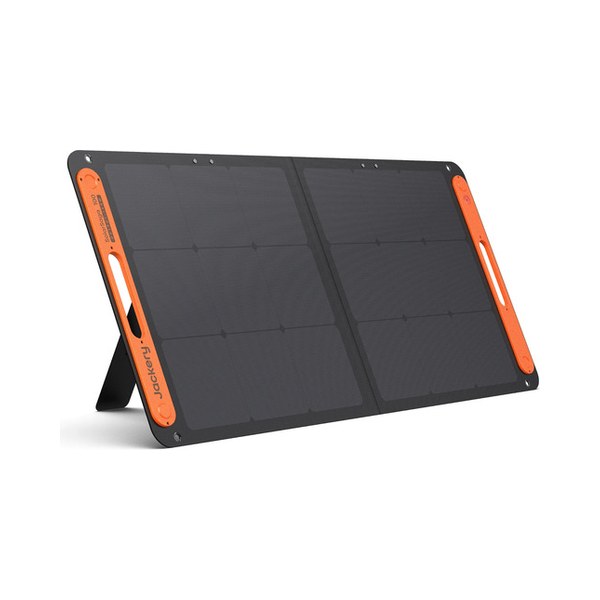
- DC8020 and DC7909. The Jackery SolarSaga 100W lists a DC8020 connector, with a DC8020 to DC7909 adapter in the box.
- Anderson-style connectors. The Jackery SolarSaga 100 Light comes with a built-in cable and adapters from Anderson to DC8020 and to DC7909.
- Unstated connectors. The Renogy E.Flex 200W page we checked does not state its connector type. Confirm it before you buy.
Specs for the Jackery panels come from a Jackery blog article, not a product page, so confidence is lower. Check the retailer page for the exact connector on the model you want.
Why matching solar panel connectors matters
Two connectors can look alike and still not match. Advanced Energy says panel leads must only connect to connectors of the same type and manufacturer. It explains that a mismatched pair may work at first, but slight differences in dimensions and materials can cause resistance. That resistance can lead to heat buildup and a failed connection over time.
The same article adds that module installation instructions often forbid mating connectors from different makers. It also notes that there is no single standard for solar PV connectors, so compatibility is not guaranteed by a common rule. Ignoring a panel's manual can also mean out-of-warranty repairs if a failure follows.
Energy Safe Victoria lists a few ways to spot a mismatch:
- Different colors or numbers of O-rings on the male connector.
- Different cable gland nut shapes.
- Different body designs on the positive and negative connectors from one maker.
- Different logos or symbols on the connectors.
If you are in doubt, ask your supplier or check the panel spec sheet. The Australian guide also says to use the manufacturer's crimping tool when you fit connectors to a cable, which matters if you build your own cables. For a home roof system, hire a licensed electrician, because local rules apply.
Older and less common types
MC4 is not the only name you will see. A guide from Spheral Solar, a seller, calls MC3 a legacy type. It also lists T4, also called Tyco Solarlok, and Amphenol H4 as other connector families. The same guide says T4 and H4 are not compatible with MC4 systems without proper adapters, and that you should never mix different connector types.
So if you buy a used panel, look at the connector first. An older panel may need an adapter to meet newer equipment. Spheral also describes MC4 as a snap-lock design with an IP67 rating. That is a seller's claim, so check the rating on the exact connector you buy.
How adapters work
An adapter changes one connector type to another. For example, a power station may have a barrel-style input, while your panel ends in MC4. A cable with an MC4 end on one side and the barrel plug on the other bridges the gap.
Use the adapter the panel or power station maker supplies when you can. Adapters add one more joint to the circuit, so a loose one wastes power. Keep it dry and fully seated, and avoid pulling on the cable.
Adapters do not change voltage or current. They only change the plug shape. So the power station's input limits still apply, and you should check them on its page.
Extension cables
If your panel cable is too short, an extension cable fixes it. Each extension adds two more joints, one on each cable, so it adds a little more resistance and one more place for a fault. Pick an extension with the same connector type as your panel, buy it from the same maker where you can and keep the run as short as the setup allows. Do not leave the joints lying in water or mud.
Series, parallel and Y-branch connectors
When you use more than one panel, you can wire them two ways.
- Series connects the positive of one panel to the negative of the next. Voltage adds up, while current stays the same.
- Parallel connects positives together and negatives together. Current adds up, while voltage stays the same.
A Y-branch connector helps with parallel wiring. It joins two panel cables into one. Whichever way you wire panels, check the power station's maximum input voltage and watts first. Exceeding them can damage the unit. Our 200 watt solar panel guide shows how panel size and input limits fit together.
A worked example: checking one pair
Say you own a power station with a barrel-style solar input, and you are looking at a panel whose page does not list a connector. The Renogy 200 W panel page we checked is like that. Here is how to check the pair, step by step.
- Ask the seller what connector the panel ends in.
- Open the power station's manual and find its solar input type and its maximum input watts and voltage.
- If the two plugs differ, look for the adapter cable the power station maker sells for that panel connector.
- Confirm that the adapter's ratings meet or exceed the panel's output.
That takes ten minutes, and it prevents the most common problem, which is a panel that arrives with a plug that does not fit.
Buying checklist
Before you order panels, cables or adapters, run through this list.
- Read the panel's connector type. If the page does not say, ask the seller.
- Read the power station's input type. Match it to the panel or find the right adapter.
- Stay with one maker. Use connectors from the same manufacturer on one string of panels.
- Check the ratings. Voltage and current ratings should meet or exceed what your panels produce.
- Plan the cable length. Longer cables lose a little more power, so keep runs short.
Mistakes to avoid
- Mixing brands. It may work today and fail later.
- Forcing a fit. If a connector does not click in easily, stop and check the type.
- Leaving joints in water. Raise connectors off wet ground.
- Skipping the manual. The panel's instructions come first.
Where connectors fit in a bigger setup
Connectors are a small part of a solar setup, but they decide whether the whole chain works. If you plan a freezer or fridge on solar, read our guides on battery backup for a refrigerator and freezer wattage. They show how much energy you need, and connectors are how that energy gets from the panel to the battery.
The bottom line
Solar panel connectors join panels, cables and power stations, and the right match keeps the system safe. MC4 is the common locking type, but many portable panels use other plugs, so check both ends and use the maker's adapter. Do not mix brands, and keep every joint dry and seated.