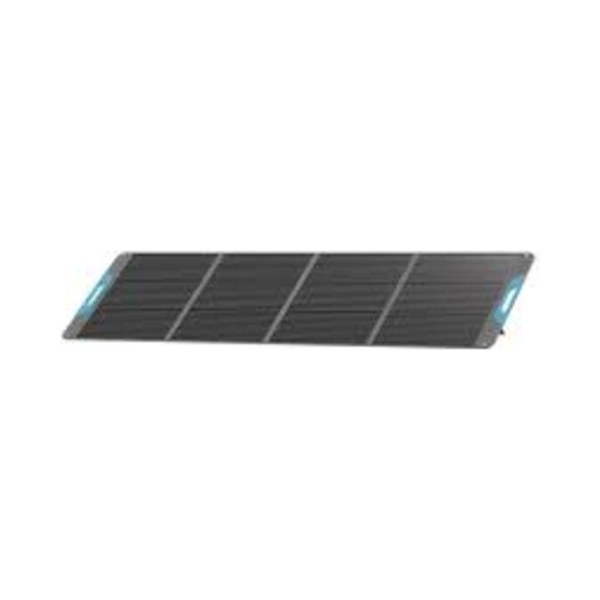
An off grid solar system makes and stores its own electricity, with no connection to the utility. It needs four basic parts: solar panels, a charge controller, a battery bank and an inverter. How big each part must be depends on your daily energy use. In the worked example below, a small setup with a refrigerator, a freezer, lights and a laptop needs about 2,400 watt-hours a day. That takes roughly four 200 watt panels and a battery near 2,800 Wh to cover one day without sun. This guide shows how to run the numbers for your own case.
We compared official product pages and a state energy office guide for this article. We did not test any system ourselves, so every figure comes from the manufacturers, a cited source or math you can repeat.
The four parts of an off grid solar system
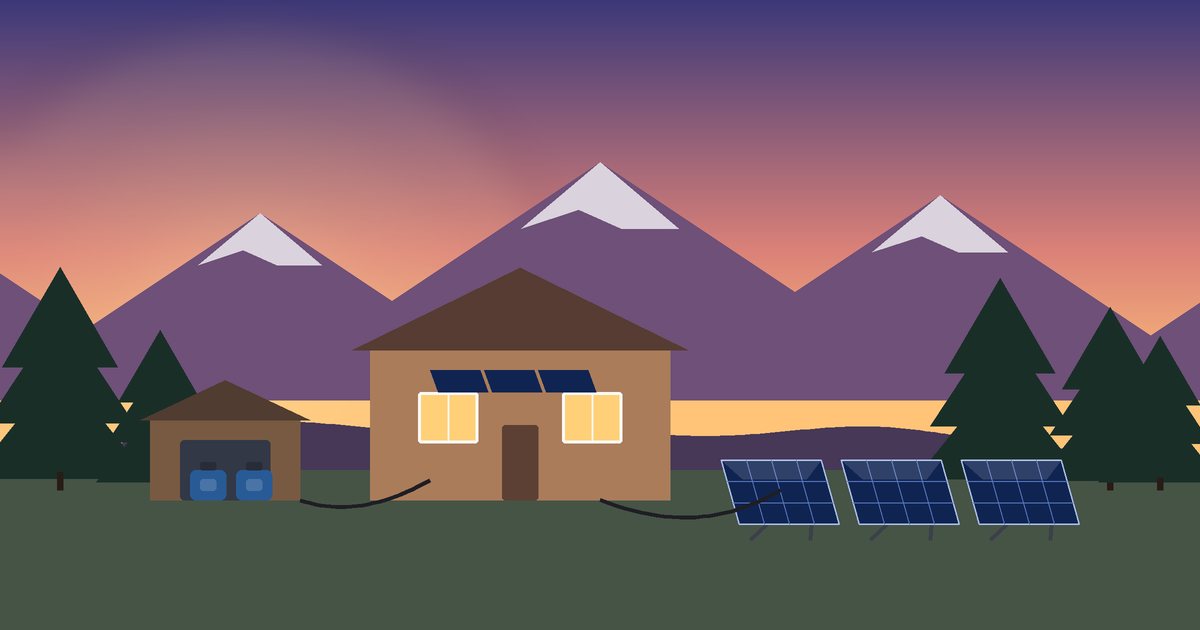
According to the South Carolina Energy Office, an off-grid system has these parts:
- Solar panels. They sit on a roof or on the ground and make direct current from sunlight.
- A charge controller. It prevents overcharging the battery.
- A battery bank. It stores extra solar energy for nighttime use.
- An inverter. It converts the battery's direct current into the alternating current your appliances use.
The same page says generators, small wind systems and other fuel sources are sometimes used as backup power. That backup matters most when stored power runs short.
A portable power station packs the battery, the charge controller and the inverter into one box. Then you connect panels to it. For a small off grid power system, that is the simplest path. For a full home, separate components and a professional design make more sense.
Start with your daily energy use
Everything in an off grid solar system depends on one number: how many watt-hours you use in a day. Panels must make at least that much. The battery must cover the hours without sun.
Make a list of every appliance. For each one, estimate watts and hours of use per day, then multiply. Here is an example with made-up loads, so swap in your own numbers.
The 215 kWh figure comes from ENERGY STAR, which says a certified chest freezer uses about that much a year. The fridge, lights, laptop and router numbers are examples, not measurements. Our guides to battery backup for a refrigerator and freezer wattage show how to find the real figures for your appliances.
An off grid fridge: the biggest steady load
Cooling is usually the heaviest steady load in a small setup. An off grid fridge and a freezer together make up about 1,700 of the 2,370 watt-hours in our example. So trimming those loads pays off most.
Some fridges run on DC power and suit cabins and RVs. They are a different product and not covered here. For most people, a standard fridge on an inverter works, as long as the inverter handles the compressor's startup surge.
How many panels do you need?
Panels never make their rated watts all day. Here is the planning method, using a 200 watt panel as an example.
- A 200 W panel in four hours of strong sun makes at most 800 Wh.
- After losses, plan on about 75% of that, which is 600 Wh. The 75% figure is our rule of thumb, not a manufacturer spec.
- Divide your daily use by 600. For 2,370 Wh, that is about 3.95, so round up to four panels, or 800 W in total.
Clouds, winter sun and shade can cut the result a lot, so a margin helps. Our 200 watt solar panel guide explains the method in more detail.
Panels also take space. The Renogy E.Flex 200W page lists a folded size of 23.72 by 22.99 inches and an open length of 87.80 inches, at 13.89 lb each. Four panels need a large clear area. Check the connector type too, because the page we checked does not state it. Our solar panel connectors guide explains why matching matters.
How big a battery do you need?
The battery covers the hours when panels make nothing. Many people size it for a full day without sun, and some plan for two.
A power station loses some energy converting battery power to household AC. We count on about 85% of rated capacity as a planning rule. For one day of 2,370 Wh, you need about 2,370 divided by 0.85, which is about 2,790 Wh of battery.
Here is how three units from our product list compare against that need:
- Jackery Explorer 2000 v2: 2,042 Wh gives about 1,735 usable Wh. That covers roughly 17 hours of our example load. Output is 2,200 W with a 4,400 W surge. It weighs 39.5 lb.
- Bluetti Elite 200 V2: 2,073.6 Wh gives about 1,762 usable Wh, or about 18 hours. Output is 2,600 W. It weighs 53.4 lb.
- Jackery Explorer 5000 Plus (Solar Generator 5000 Plus): 5,040 Wh gives about 4,284 usable Wh, or about 43 hours. Output is 7,200 W with a 14,400 W surge. At 134.5 lb, it is not portable in practice.
The two 2,000 Wh units fall short of a full day in this example. So you would add a second battery, cut some loads or accept a gap. The 5,000 Wh unit covers about a day and three-quarters.
Prices and availability change often, so check the retailer page before you decide.
The inverter and the surge
The inverter must handle two numbers: the total running watts of everything on at once, and the biggest startup surge. A refrigerator's compressor pulls a short burst when it starts. All three units above offer far more output than our example needs, so the surge is not the limit here. For a bigger home, add up the loads that could run together.
If you plan to wire a system into a house, hire a licensed electrician. Local codes and permits apply, and mistakes can cause fires or shocks.
Where a generator fits in
Solar alone struggles through long cloudy stretches. A generator can fill the gap. You can run it only when the battery is low, which uses less fuel than running it all day. Remember the safety rule: portable generators run outdoors only, away from doors, windows and vents. Our apartment backup guide covers that rule.
Cut the load before you add panels
Every watt-hour you save is a watt-hour you do not have to generate or store. So trim loads first, because that is cheaper than buying more panels.
Here is one example from the numbers above. ENERGY STAR says a certified chest freezer uses about 215 kWh a year, while a certified upright uses about 395 kWh. The gap is 180 kWh a year, or about 490 Wh a day. That is roughly four-fifths of one 200 W panel's good-day output. So choosing a chest freezer over an upright saves most of a panel.
Start small and grow
You do not have to build the whole system at once. If you are new to this, a stepped plan lowers the risk.
- Measure. Use a plug-in watt meter on your loads for a week and write down the numbers.
- Test small. Run a power station and one or two panels for the most important loads. Watch how the battery behaves over several days.
- Expand. Add panels and battery capacity only after you see how much sun you really get.
Because winter sun is weaker than summer sun, test in the season you worry about most. For example, a system that works in July may fall short in December.
Mistakes to avoid
- Guessing your loads. Measure or read labels instead.
- Sizing for a perfect day. Plan for cloudy days, not the best day of the year.
- Forgetting the surge. A battery with enough watt-hours can still trip on a compressor start.
- Mismatched connectors. Check them before you order panels.
- Skipping a margin. Add 20% or more to your estimates.
Remember that every figure here is an example. However, the method works for any home, because it starts from your own loads. So write the list first, then size the parts.
The bottom line
An off grid solar system comes down to four parts and one number, your daily watt-hours. Add up your loads, divide by what one panel makes, then size the battery for the hours without sun. In our example, that is about four 200 watt panels and a battery near 2,800 Wh. Start small, measure your real use and grow the system as you learn.