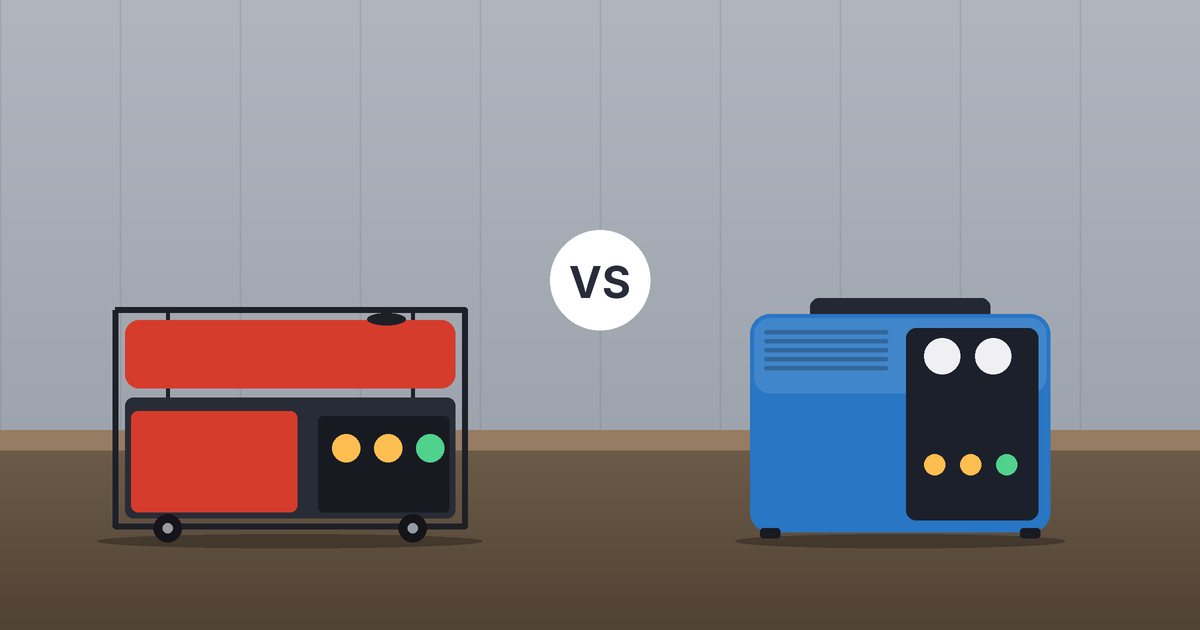
In the genset vs inverter choice, a genset is a conventional engine-driven generator that runs at a steady speed. An inverter is either an inverter generator, which adjusts engine speed to the load, or a battery-based device that makes household power with no engine at all. Pick a genset for high power at a lower price per watt. Pick an inverter generator for quieter, steadier power. Pick a battery-based inverter for short outages with no fumes. This guide untangles the three, then tests them on a sump pump.
We compared official spec pages for four models. We did not test them, so every figure comes from the manufacturers or from simple math you can repeat.
Why genset vs inverter is confusing
Two words cause the trouble. "Genset" is short for generator set, and it usually means a conventional generator. "Inverter" appears in two kinds of product.
- An inverter generator burns fuel. It makes raw power, then an electronic circuit turns it into steady household power. Our inverter vs conventional generator comparison covers this in detail.
- A battery inverter, such as a portable power station, stores energy in a battery and uses an inverter to produce household power. There is no engine.
A plain power inverter, with no battery in the box, needs a battery from somewhere else. A power station already includes one. So when you see "portable inverter" or "rechargeable inverter" in a search, check which product it is.
Genset, inverter generator and battery inverter at a glance
| Genset | Inverter generator | Battery inverter | |
|---|---|---|---|
| Energy source | Gasoline or propane | Gasoline or propane | Battery |
| Engine | Yes | Yes | No |
| Exhaust | Yes, outdoors only | Yes, outdoors only | None |
| Noise | Highest | Lower | No engine noise |
| Runtime | As long as you add fuel | As long as you add fuel | Limited by battery |
| Power quality | Can vary more | Steady | Steady |
However, treat the power quality row as a general pattern, not a rule.
What the spec sheets say
| Model | Type | Running / peak | Weight | Noise |
|---|---|---|---|---|
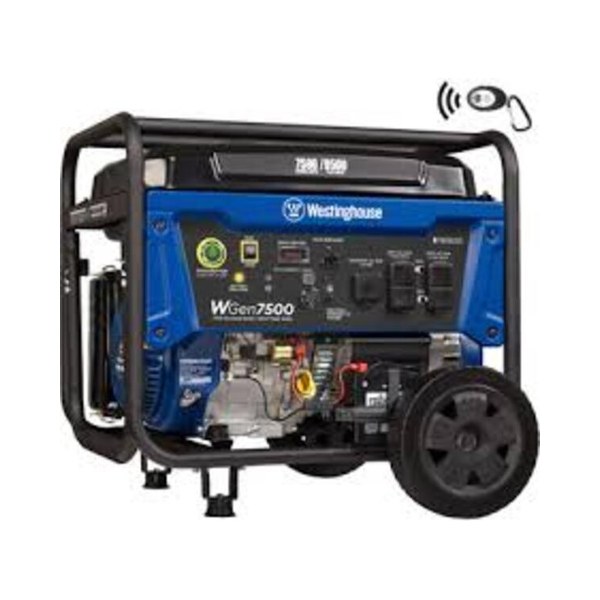
| Westinghouse WGen7500 | Genset | 7,500 / 9,500 W | 196 lb | 72 dBA (load not stated) |
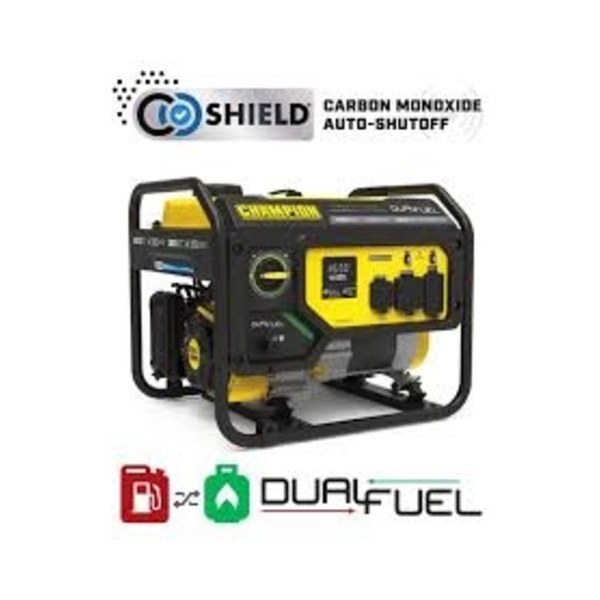
| Champion 201213 | Genset, dual fuel | 3,500 / 4,000 W | 108 lb | 68 dBA from 23 ft |
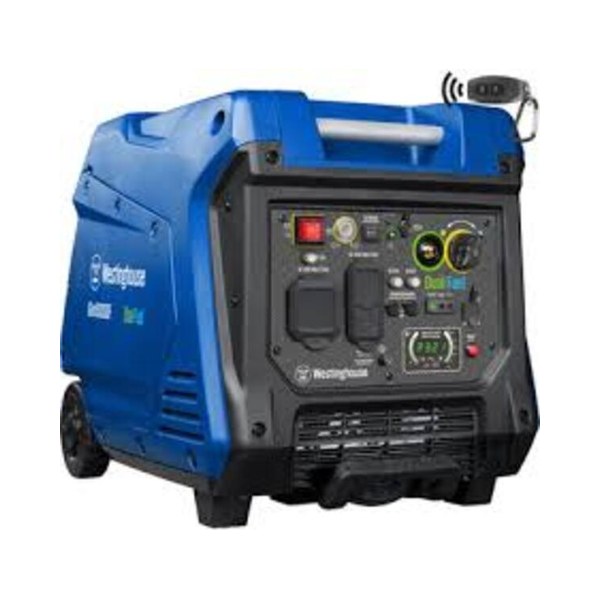
| Westinghouse iGen5000DF | Inverter generator, dual fuel | 3,900 / 5,000 W | 104.7 lb | 52 dBA (load not stated) |
| Jackery Explorer 1000 v2 | Battery inverter | 1,500 / 3,000 W | 23.8 lb | No engine |
Each maker tests noise differently, so treat the last column as a rough ranking. Two points stand out. The two gensets are the loudest, and the battery unit is the lightest by far, although it holds only 1,070 Wh.
A test case: an inverter for a sump pump
Because a sump pump is a common reason to look for backup power, we use one as a test. Say your pump runs 800 W and surges to 2,400 W when it starts. Those are example numbers, so check your pump's label.
Here is how each type handles it.
- Westinghouse WGen7500: 7,500 W running covers 800 W with huge room to spare. The 9,500 W peak covers the surge. It is far larger than the job needs.
- Champion 201213: 3,500 W running and 4,000 W peak cover it. On propane, 3,150 W and 3,600 W also cover it.
- Westinghouse iGen5000DF: 3,900 W and 5,000 W cover it, and the inverter engine slows down when the pump rests.
- Jackery Explorer 1000 v2: 1,500 W covers the 800 W running load, and its 3,000 W surge covers the 2,400 W start. So the surge is fine. Runtime is the question.
For runtime, say the pump runs about 15 minutes in every hour. That is an assumption, so your pump may differ. It uses about 200 Wh an hour. A power station loses some energy converting battery power to household AC, and we count on about 85% of rated capacity as a planning rule. The Jackery's 1,070 Wh gives about 910 usable Wh, so about 4.5 hours. A gas unit runs as long as you add fuel.
So a battery inverter works for a short outage, and a gas unit works for a long one. Our guide to battery backup for a refrigerator shows the same math for a fridge.
Where a genset wins
A genset tends to deliver the most power for the least money. The WGen7500 gives 7,500 W running, which is enough for a house with a 120/240 V outlet. It is a good fit when noise and weight do not matter, such as on a job site or in a workshop away from neighbors.
The tradeoff is size and noise. At 196 lb, the WGen7500 needs wheels. At 72 dBA, neighbors will hear it. Its spec table also lists no carbon monoxide sensor, so you need an alarm in your home.
Where an inverter generator wins
An inverter generator is quieter and gentler on electronics. The iGen5000DF lists 52 dBA and runs on gasoline or propane. It lists 18 hours on gasoline at 25% load. The engine slows down at light loads, which saves fuel.
The tradeoff is price per watt. We list no prices because they change, but inverter models often cost more per watt than conventional ones, so compare current prices. The iGen5000DF also lists no CO sensor.
Where a battery inverter wins
A battery unit has no engine, so it makes no exhaust and no engine noise. You can use it where a generator is not allowed, such as an apartment. Its limits are energy and power. The Jackery lists 1,500 W and 1,070 Wh, so it cannot run big appliances for long. Our apartment backup guide explains why many renters pick a battery.
You can also refill it from solar panels. Our off-grid solar system guide explains how to size panels and a battery.
Fuel options and output
However, both gas types may run on propane, and then the output changes. The Champion 201213 genset lists 3,500 W on gasoline and 3,150 W on propane. The Westinghouse iGen5000DF inverter generator lists 3,900 W on gasoline and 3,500 W on propane. Both lose about 10% on propane. So size for the lower number if you plan to use propane. The WGen7500 in our list is gasoline only.
Noise in a neighborhood
Noise matters when neighbors are close. The WGen7500 lists 72 dBA, the Champion lists 68 dBA from 23 feet and the iGen5000DF lists 52 dBA. The makers use different tests, so treat the gap as a hint. Even so, the inverter model is clearly the quieter choice here, and a battery unit has no engine at all.
Which one for which job
- Job site, workshop or large home: a genset such as the WGen7500, for high power.
- Camping, tailgating or a quiet street: an inverter generator.
- Apartment, balcony or short outage: a battery unit.
- A sump pump for several days: a gas unit, or a large battery with solar.
Safety applies to the engine types
The U.S. Consumer Product Safety Commission says to use portable generators outside only, at least 20 feet from doors, windows and vents. It also says never to use one inside a home or garage, even with doors and windows open. That rule covers both gensets and inverter generators. A battery inverter has no exhaust, but you should still follow the manual for placement.
How to choose
- List your loads. Add the running watts and find the biggest surge.
- Pick the outage length. A night favors a battery. Several days favors a gas unit.
- Check the place. Apartments and campgrounds often rule out gas.
- Think about noise. Gensets are loudest.
- Compare cost per watt. Check current prices for the models you like.
A note on cost
We list no prices, because they change often. Still, the pattern is useful. A conventional genset often costs less per watt, an inverter generator often costs more for its quiet and clean power, and a battery unit can cost more per watt of output. Compare current retailer prices for the sizes you calculated, and count fuel as a running cost for gas units.
Common mistakes
- Mixing up the words. Check whether a "portable inverter" has an engine or a battery.
- Ignoring the surge. A pump may start at three times its running watts.
- Forgetting propane. Output drops on propane.
- Running it indoors. Gas units go outside only.
The bottom line
In the genset vs inverter choice, a genset gives the most power for the money, an inverter generator gives quieter and steadier power, and a battery inverter gives silent, fume-free backup for short outages. Size for your loads first, then pick the type. For a sump pump, a small unit of any type covers the surge, and the real question is how long you need it to run.