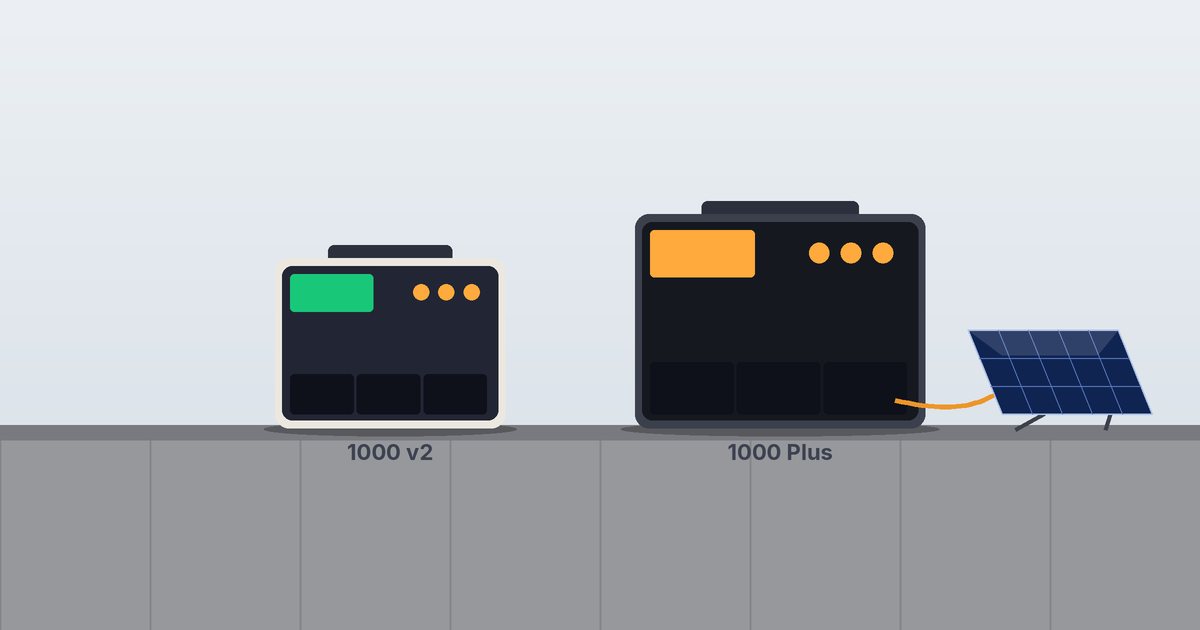
The Jackery 1000 name covers two different power stations: the Explorer 1000 v2 and the Explorer 1000 Plus. At 23.8 lb, the v2 is lighter and holds 1,070 Wh. The Plus holds 1,264 Wh, puts out 2,000 W and accepts up to 800 W of solar. This guide compares them with figures from Jackery's own pages. We did not test either one, so every number comes from the maker or from simple math you can repeat.
Jackery 1000 v2 vs 1000 Plus at a glance
| Explorer 1000 v2 | Explorer 1000 Plus | |
|---|---|---|
| Capacity | 1,070 Wh | 1,264 Wh |
| Rated / peak output | 1,500 / 3,000 W | 2,000 / 4,000 W |
| Weight | 23.8 lb | 32 lb in the spec table |
| Size (inches) | 12.87 × 8.82 × 9.72 | 14 × 10.24 × 11.14 |
| AC outlets | 3 (120 V) | 3 (120 V) |
| USB ports | 1 USB-A (18 W), 2 USB-C (30 W and 100 W) | 2 USB-A (18 W), 2 USB-C (100 W) |
| Solar input | Up to 400 W | Up to 800 W |
| Wall recharge | 1.7 hours, or 1 hour in fast mode | 1.7 hours |
| Solar recharge (Jackery's figure) | 3.8 hours with two 200 W panels | 2.5 hours with four 200 W panels |
| Car recharge | 12 hours | 7 hours |
| Expandable | No | Yes, up to about 5 kWh |
| Warranty | 3+2 years | 3+2 years |
Both use LiFePO4 cells rated for 4,000 cycles to 70% capacity. Both list about 20 ms of switchover when you use them as a backup, and both work with the Jackery app.
The Plus weight needs a note. The spec table lists 32 lb, while a feature line on the same page says 24 lb. We use 32 lb, but check the page before you order.
Power: what 1,500 W and 2,000 W mean
Think of watt-hours as the size of a fuel tank and watts as the width of the pipe. A wide pipe lets you draw a lot at once, and a big tank lasts longer. Rated output is the width of the pipe: the most you can draw at one time. Add up the running watts of every device you plan to use together. If the total is above the rated output, the unit shuts down or trips.
Here are example loads. These numbers are assumptions, so check the label on your own devices.
| Example load | Running watts | 1000 v2 (1,500 W) | 1000 Plus (2,000 W) |
|---|---|---|---|
| Laptop | 60 W | Yes | Yes |
| Microwave | 1,100 W | Yes, alone | Yes, with a small load |
| Electric kettle | 1,500 W | At the limit | Yes |
| Microwave and kettle together | 2,600 W | No | No |
So the 1,500 W output limits the v2 to one or two mid-size appliances at a time. The Plus gives you more room, but not enough for two heating appliances at once. Motors, such as a fridge compressor, draw more for a moment when they start. The peak ratings, 3,000 W and 4,000 W, cover that moment, but check your appliance's startup surge. Do you really need 2,000 W? If your biggest loads are a fridge and a laptop, probably not.
Capacity: how long each one runs
Capacity tells you how long a load lasts. After conversion losses, we plan on about 85% of rated capacity. That is our rule of thumb, not a Jackery spec.
- 1000 v2: 1,070 Wh times 0.85 gives about 910 usable Wh.
- 1000 Plus: 1,264 Wh times 0.85 gives about 1,074 usable Wh.
Divide usable watt-hours by your load in watts to get hours. For example:
| Example load | 1000 v2 | 1000 Plus |
|---|---|---|
| Fridge averaging 46 W | About 20 hours | About 23 hours |
| Laptop at 60 W | About 15 hours | About 18 hours |
| Microwave at 1,100 W | About 50 minutes | About an hour |
The Plus runs about 18% longer on the same load. That is a real gain, but it is not a different class. If you need a full day or more, look at a larger unit. Our guide to battery backup for a refrigerator explains how to find your own fridge's number, and our 1000W power station guide covers the 1,000 Wh class in general.
Solar input and recharging
Solar input is where the two models differ most. The v2 accepts up to 400 W of panels. The Plus accepts up to 800 W, with a listed input range of 12 to 60 V.
Jackery's recharge figures use different setups. The v2 figure is 3.8 hours with two 200 W SolarSaga panels. The Plus figure is 2.5 hours with four 200 W panels. Because the panel counts differ, the two numbers do not show which unit charges faster per panel. Real sun, clouds and panel angle change the result, so treat them as best-case figures.
If you plan to add panels, match their voltage and connectors to the input. Our solar panel connectors guide explains how, and our 200 watt solar panel guide shows how much energy a panel makes in a day.
For the car port, the lists differ too. Jackery gives 12 hours for the v2 and 7 hours for the Plus. We repeat these numbers as listed and have no way to explain the gap.
Expansion: the Plus advantage with a catch
Only the Plus can add battery packs. Jackery says it can grow from about 1.2 kWh to about 5 kWh, with up to three packs. That is a strong reason to pick it if you may want more runtime later.
There is a catch. The product page lists the add-on Battery Pack 1000 Plus as discontinued. So do not buy the Plus for expansion until you have confirmed that you can still get a pack. If you cannot, the Plus is simply a 1,264 Wh unit with more output.
Ports and temperature limits
Both models have three 120 V AC outlets and a 12 V car port rated at 10 A. The USB side differs a little. On the v2, you get one USB-A port at 18 W and two USB-C ports, one at 30 W and one at 100 W. The Plus has two USB-A ports at 18 W and two USB-C ports at 100 W. So the Plus charges two laptops at full USB-C speed, while the v2 does it for one laptop plus a slower phone or tablet.
Temperature matters in a garage or a cold car. Jackery lists the same range for both: charging from 32°F to 113°F and discharging from 14°F to 113°F. In a freezing garage, bring the unit indoors before you recharge it. The Plus page also gives a slightly narrower discharge range in its FAQ, up to 104°F, so avoid leaving either unit in a hot car.
Weight and size
Going by the spec table, the v2 is about 8 lb lighter than the Plus, and it is a little smaller in every direction. If you carry the unit from a car to a campsite, or move it room to room, the lighter v2 is easier to live with. If it stays by the fridge in a garage, the weight matters less.
Which Jackery 1000 should you choose?
Choose the Explorer 1000 v2 if:
- you carry it often, for car camping or trips;
- your loads stay under 1,500 W;
- you want backup for a fridge, a router and a few devices through a night.
Choose the Explorer 1000 Plus if:
- you need up to 2,000 W of output;
- up to 800 W of solar is part of your plan;
- you may want to add battery packs, after you confirm they are available.
If your needs are small, such as phones and a laptop, both are more than you need. Look at a smaller unit instead. Our Jackery models guide compares the whole lineup from 288 Wh to 5,040 Wh.
What buyers say about each model
The two models are rated by buyers on different sites, so read the numbers as two separate samples, not a head-to-head score. We did not read every review. All figures are as of October 25, 2026.
Jackery 1000 v2 on Amazon
Amazon.com shows 3,710 customer ratings for the Jackery Explorer 1000 v2, with an average of 4.7 out of 5. Of those ratings, 86% are five stars and 3% are one star. Amazon builds its topic summary from the review text. The table shows how many reviewers mention each topic.
| Topic | Reviewers who mention it | Positive | Negative |
|---|---|---|---|
| Charging speed | 358 | 290 | 68 |
| Value for money | 220 | 176 | 44 |
| Durability | 194 | 137 | 57 |
| Power | 173 | 144 | 29 |
| Functionality | 127 | 121 | 6 |
| Portability | 112 | 110 | 2 |
| Power backup | 100 | 100 | 0 |
| Weight | 96 | 71 | 25 |
Buyers praise fast charging, and Amazon's five-star summary says most report a full charge in one to two hours on AC. Some say it ran a 16 cubic foot refrigerator for about 6.5 hours, a 12 V fridge for two days, or a CPAP machine for four nights on DC power. The complaints are about durability, price and weight. A few reviewers say the unit failed within a month, and others say the output cut out at night. Amazon's summary also notes that some port adapters are not included.
Jackery 1000 Plus on Jackery.com
We could not find the 1000 Plus listed on Amazon, so this data comes from Jackery's own store. Jackery.com shows 121 reviews with an average of 4.7 out of 5. Of those, 100 are five stars, 15 are four stars, 2 are three stars and 4 are one star. These are reviews on the seller's own site, and the same reviews are shared by the station and its solar kits. For that reason, we leave out remarks that are only about the solar panels. We went through the review pages as shown, although some long reviews are cut off on the page. Jackery's own "Customers say" summary points to reliability, charging in under two hours from an outlet, quiet operation and the expandable battery.
Buyers use it for camping, vans, trailers and refrigerators. One reviewer ran a 2.7 cubic foot fridge-freezer for almost 48 hours. Another ran a 50 quart fridge around the clock plus a coffee maker. A third, who also owns the smaller Explorer 300, says it weighs about the same as that unit despite the larger capacity. Several mention a CPAP machine, with one reporting about three days when the heated tube and humidifier were on.
The complaints are fewer but specific. Four buyers gave one star. Two say the unit stopped charging or turning on, one after less than a month and another after six months with an F0 error code. The second of those says support was slow to reply. The other two one-star reviews are about a promotion and about solar panels that differed from the listing. Others say the unit is heavy, that the manual is small and mostly online, and that one free carrying case arrived as the wrong one. One reviewer also notes that the unit drains its battery noticeably while idle with the inverter on, so switch it off when you are not using it.
These are buyers' reports, not our measurements. Use the specs above to match the unit to your load.
Using either one as outage backup
Both units list about 20 ms of switchover when the wall power fails and you run them as a backup. That is quick, but it is not zero. For a fridge, a router or a lamp, it rarely matters. For a desktop computer or medical gear, check the device maker's guidance first, and do not rely on a power station as the only protection.
Plan the outage before it happens. Charge the unit fully, test your plug-in loads once, and keep the unit in a dry place indoors. For longer outages, add panels, as in the solar section above.
A note on older Jackery 1000 models
People also search for the original Explorer 1000 and the 1000 Pro. Jackery's comparison page covers those too. This guide compares only the two models in our product data, the Explorer 1000 v2 and the Explorer 1000 Plus. Check which model a listing really sells, because the names are close.
Check these before you buy
- Weight. Confirm the Plus number on the day you order, because its page gives two.
- Battery packs. Confirm that the add-on is for sale if you want to expand.
- Warranty. Both pages list "3+2 years." We did not confirm what the extra two years require, so read the terms.
- Price and stock. We list no prices because they change often. Check the retailer page.
- Your loads. Write down the running watts and the startup surge of your biggest appliance first.
The bottom line
The Jackery 1000 v2 is the lighter, simpler pick for short outages, camping and a fridge for a night. The Jackery 1000 Plus gives more output, more capacity and room for up to 800 W of solar, with an expansion option you should verify before you count on it. Match the choice to your heaviest load and to how far you carry it. Start from our guide to choosing a portable power station if you are still comparing sizes.