The right food truck generator depends on one number: the total watts your equipment pulls when it runs, plus the largest startup surge. As a rough guide, small setups often land in the 3,000 to 4,000 watt range, and a full cooking line can need 5,000 watts or more. Your equipment list decides. This guide shows how to size it, what noise figures mean and which models suit different trucks.
Size your food truck generator from an equipment list
Write down every appliance that could run at the same time. Include the fridge, a freezer, lights, a point-of-sale tablet, a fan or a hood and every cooking appliance. Then find each one's wattage on its nameplate or in its manual.
Add the running watts of everything that runs together. That total is your base load.
Next, find the biggest startup surge among your motor-driven items, such as a compressor or fan. Motors pull extra power for a moment when they start. Count that biggest motor at its surge watts instead of its running watts. Motors rarely start at the same instant, so you do not add every surge.
A quick example, with made-up numbers you should replace with your own: a 700 W fridge, 500 W of lights and electronics and a 1,500 W griddle add up to 2,700 W. If the fridge surges to 2,100 W for a moment, swap its 700 W for 2,100 W and the peak comes to roughly 4,100 W. Check two ratings: the running watts must cover 2,700 W, and the peak rating must cover 4,100 W. A common rule of thumb is to leave about 20% of headroom so the engine does not run flat out all day.
A sample power budget
Here is a made-up truck, so swap in your own numbers.
| Equipment | Running watts (example) |
|---|---|
| Refrigerator | 700 |
| Lights and tablet | 300 |
| Griddle | 1,500 |
| Food warmer | 800 |
| Total | 3,300 |
Now count the fridge at a 2,100 W surge instead of 700 W. The peak becomes 3,300 − 700 + 2,100 = 4,700 W. You need a generator whose running watts cover 3,300 W and whose peak rating covers 4,700 W.
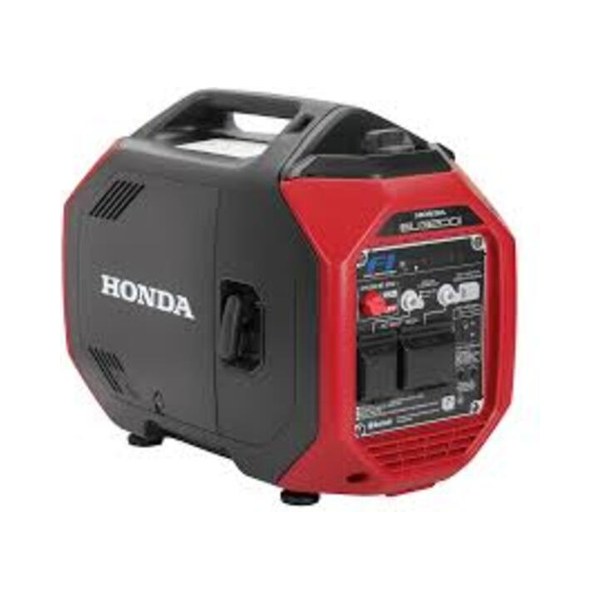
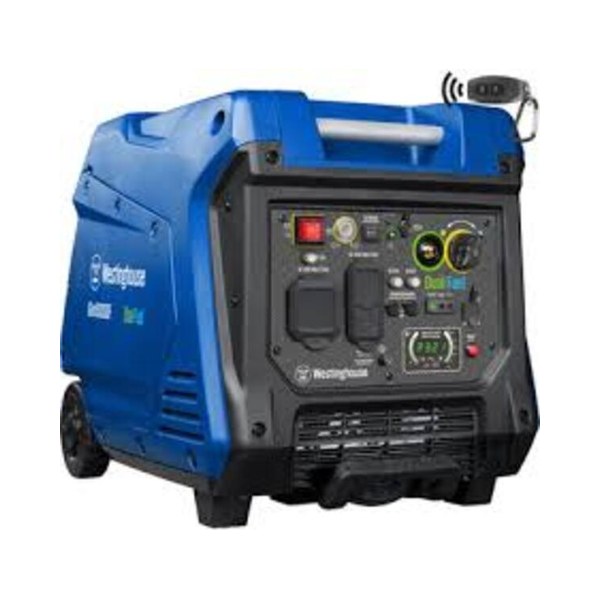
Against that list, the Honda EU3200i falls short at 2,600 W running. The Champion 201321 covers the 3,300 W running load, but its 4,500 W peak misses 4,700 W. The Westinghouse iGen5000DF, at 3,900 W running and 5,000 W peak, clears both numbers with a thin margin. The Honda EU7000iS clears them easily. Your list will differ, but the method holds.
Why noise matters for a food truck generator
Customers stand next to your truck. A generator that roars makes it hard to take orders, and some venues limit noise.
Inverter generators run quieter because the engine speeds up and slows down with the load. Manufacturers state noise in dB(A), but they measure it under different conditions. Honda lists 58 dB(A) at rated load for the EU3200i. Westinghouse lists 52 dBA for the iGen5000DF without saying at what load. Champion lists 64 dB(A) for its open-frame 201321. Because the test conditions differ, treat these numbers as a rough ranking, not an exact comparison.
Food truck generator models worth looking at
All details below come from the manufacturers' spec pages.
- Honda EU3200i puts out 2,600 W running and 3,200 W at peak. It weighs 59.1 lb and runs about 3.3 hours at rated load, or 8.6 hours at a quarter load. The short runtime at full load means refueling during a long service.
- Westinghouse iGen5000DF gives 3,900 W running on gasoline and runs on gasoline or propane. It lists 18 hours on gasoline or 22 hours on propane at 25% load. No CO sensor appears in its spec table.
- Champion 201321 is an open-frame inverter with 3,650 W running and 4,500 W at peak. It is dual fuel and offers a 30 A RV outlet. At 64 dB(A), it is louder than the enclosed inverters here.
- Honda EU7000iS delivers 5,500 W running and 7,000 W at peak. It suits a fuller cooking line. It weighs 263.2 lb, so you will not lift it by hand.
Prices vary, so check current listings before you decide. Our best portable generators guide compares more models.
Plan your fuel for a long day
A food truck generator burns fuel fastest under heavy loads. Runtime figures come from the manufacturers, and they assume light loads. Westinghouse lists the iGen5000DF at 18 hours on gasoline or 22 hours on propane at 25% load. Champion lists the 201321 at 22 hours on gasoline or 21 hours on propane at a quarter load. Honda lists the EU7000iS at 6.4 hours at rated load and 16.0 hours at a quarter load.
Now compare that to the sample budget. A 3,300 W load sits near 85% of the iGen5000DF's running output, far above a 25% load. Expect a much shorter runtime than 18 hours, and plan your refuels around the heavy end of the range.
Check outlets and fuel
Food trucks may need a 30 A outlet for a panel or a larger appliance. The Champion 201321 and the Westinghouse iGen5000DF both list a TT-30R outlet, while the Honda EU3200i lists a 30 A locking outlet. When you shop for a food truck generator, confirm that the plug type matches your truck's wiring.
The Champion 201321 also lists parallel ports, so check its page to see what you need to link two units. Fuel choice matters too. Propane keeps in a tank without going stale. Gasoline is easier to find. Dual-fuel models like the iGen5000DF and the 201321 let you carry either. For gasoline basics, see our guide to portable gas generators.
Safety comes first
Carbon monoxide is the main risk. The U.S. Consumer Product Safety Commission says to use portable generators outside only, and to keep them at least 20 feet from doors, windows and vents. It also says to install battery-operated or plug-in carbon monoxide alarms with battery backup.
That advice is written for homes. A truck is a tight space, so the same logic applies: never let exhaust drift toward the serving window or the door. Follow the manufacturer's manual and your local rules for placement and permits.
A day at the market
Picture an eight-hour weekend market with your food truck generator running from open to close. You run a fridge, lights and a small cooktop. Honda lists 3.3 hours at rated load and 8.6 hours at a quarter load for the EU3200i. Your real load lands between those two figures, so an eight-hour service means planning at least one refuel. Carry a spare fuel can and store it away from the truck.
If your load is smaller, see our 2,000 watt generator guide and our look at small generators. To see why most truck owners lean toward the quieter type, read our inverter vs conventional generator comparison.
The bottom line
A good food truck generator matches your equipment list. Add up your equipment, count the biggest motor at its surge, then pick a generator with some headroom. Choose an inverter model if noise matters. Confirm outlets and fuel before you buy, and keep exhaust away from the truck. The models above are starting points drawn from official specs, not test results.